Friday, 15 December 2023

Rejoice In and For His Presence!

 (Homily for the 3rd Sunday of Advent Yr. B)

          Today is the third Sunday of Advent, otherwise known as Gaudete Sunday, as such, it is a Sunday to be joyful. But one could easily ask: what is the source or reason for this joy? The motive for and of this joy is the presence, the impending coming of the Messiah and his promised Salvation. A Sunday to rejoice in and for the Savior who is already in our midst and yet who is to come. The joy of Advent and specifically of this Sunday emanates from the certainty of his presence, a joy of anticipation and a joy of oasis in the wilderness. The readings of today offer us the opportunity to complete our knowledge about the One who is to come. Last Sunday St. Mark presented Him with the titles of Christ and Son of God (that is about his being), but today John adds the title of Savior (that is, about his action). All the readings of the period of advent stress particularly on the theme of salvation, but today’s readings do so in an intense manner. In the different readings we see a sort of a hymn of salvation. Indeed, we could say after a proper reflection on our Advent journey so far, that while the first two Sundays of the Advent Season laid much emphasis on the eschatological coming of the Lord, the third Sunday focuses our attention adequately on the Lord already present among us.

          In the first reading taken from the prophecy of Isaiah (Is 61:1-2.10-11), the prophet tells us that he is sent by God to announce the joyful message of salvation to the people of Israel, to a people in bondage and he says: “I exult for joy in Yahweh, my soul rejoice in my God, for he has clothed me in garments of salvation” (v.10). This passage of Isaiah’s prophecy is taken from the Trito-Isaiah. Here, the context is the return from exile, for when the Israelites returned from exile they saw that everything was in ruin, in shambles, these situations put them to desolation and despair. It was in this desolate moment that Isaiah speaks to them of the anointed One who is to bring Good tidings to the poor, healing to the broken hearted, liberty to captives, release to prisoners and a year of jubilee. This indeed, was for those that just returned from exile, a message of Great hope. Thus, in those tangible and concrete signs, the Messiah is to be recognized in every age, including our own, for he is still going around doing good and healing people.

          Furthermore, the Christian tradition saw in this prophetic message, not only a message of hope, but more importantly, the figure of the long awaited Messiah, Jesus. As a matter of fact, this passage seemed to have influenced Jesus’ comprehension of his own mission. For this was the prophetic passage Jesus quoted when he entered the Synagogue and was handed on the Scroll, and at the end he says “this passage is been fulfilled as you listen to me” (Lk. 4:21), thus his presence brings the prophecy to fulfilment. This passage of Israel’s prophecy brought to light the theme of joy in view of the imminent advent of God’s salvation. This theme is equally reconfirmed by St. Luke in today’s responsorial psalm, these words resounds again through the Magnificat of Mary “my spirit rejoices in God my Savior” (Lk. 1:47).

          The second reading (1Th. 5:16-24) continues to reinforce the message and theme of joy, raised in the first reading. St. Paul exhorts us to “Rejoice always. Pray unceasingly. In all circumstances give thanks” (vs. 16-18). His first Letter to the Thessalonians from which today's Second Reading is taken, is the earliest letter St. Paul wrote and possibly, the oldest Christian manuscript. This letter is important for it gives us a glimpse into the life of the early Christian community, struggling to live out its faith in a harsh atmosphere of hostility and persecution and wrestling with issues concerning the future coming of the Lord Jesus. Indeed, some Thessalonians expected the Lord's Second Coming to occur in their lifetime and others were discouraged by its delay. In today's passage, St. Paul urges the early Thessalonian Christians to embrace a way of life oriented to God in joy, prayer and thanksgiving. So, strengthened by the belief that God is faithful, let us live the Advent Season not in passive expectation, but in a celebration of life, in openness to the workings of the Spirit that is filled with enduring joy, unceasing prayer and constant thanksgiving. Be that as it may, during the period of Advent, our readings oscillate from the themes of the second coming to that of the first coming. In that bid, the spirituality of Advent is not akin to the contemplation of the first coming, relegating the second at the backdrop, and vice versa.

          The Gospel passage (Jn. 1:6-8.19-28) presents the Logos hymn. In this passage the absolute “beginning” of (the Logos) in verses 1-2 is here contra posed by the historical “beginning” of (John) in verses 6-8, which consists in the witness of John. The evangelist in this prologue glaringly speaks about the personality of John the Baptist by via negative: “He was not the Light, but only a witness to the Light”. The gospel passage in fact wants to show the relationship between Jesus and John. It is within the context of light and darkness that the reference to John is made. However, his purpose was clearly limited to one function, namely, to testify to the light. He told his audience that he is not the light, but the one who bears witness to the light which enlightens consciences by means of faith and radiates joy. The evangelist in the second paragraph reinforces his opinion on John, he repudiated any messianic title to John. He vehemently opined that he is neither the Christ nor the Elijah, but only the voice as in the fortieth chapter of the prophecy of Isaiah.

          In the passage of today’s Gospel we see two different groups of people: the priests and the Levites on the one hand and the Pharisees on the other, who were sent to question John the Baptist about his self-identity, role and authenticity. Who are you? They questioned him. He did admit: “I am not the Christ”. “What then are you? Are you Elijah?” He responded “I am not”. They interrogated him further: Are you the Prophet?  He in humility declares that he is not the Christ, he is not Elijah, but only “a voice that is crying in the wilderness”. John admits that he is not the Christ, yet he also insists on the reality and importance of the role he plays in God's plan as the precursor. He tells them that he was called upon to baptize with water and as one who prepares the way of the Lord. For the second time, some Pharisees were equally sent, as if they were not satisfied with his answers. They asked him: “Why then do you baptize if you are not the Christ or Elijah or the Prophet?” Then John answered bringing to the fore, the difference between his baptism and that of Jesus. For he says “I baptize with water, but there is one standing among you whom you do not recognize, the one who is coming after me”. The word of God reminds us today of the virtue of humility. And John the Baptist teaches us by his Humility as a Voice, he is not the Word, and he was very much aware of it. For a voice without the Word will only make empty noise.

          The Gospel passage ends with the declaration of John the Baptist, “There is one among you whom you do not recognize, the one who is coming after me, whose sandal strap I am not worthy to untie” (vs. 26-27). Even today, do we really recognize Him? Do we recognize him in the poor, in those who suffer and in the abandoned? To use the words of Mathew 25 do we recognize Him in the least of his brothers? He is the ever-present God, He is the Emmanuel, but do you recognize Him in your life. St. John presented Him as the One who comes (v.26), this indeed points to the certainty not only of his presence, but equally of his Coming. Little wonder, we have to rejoice for God is among us. The Scripture Readings of today remind us that true joy and happiness is to be found only in God. Yes, indeed, Advent is a time of joyful anticipation and a time of preparation.

          Indeed, the readings of today are replete undoubtedly with reasons for joy. For the Prophet Isaiah promises that justice shall be done; St. Paul assures that Christ will come, while St. John preaches vehemently that he is already in our midst. Thus, the Joy of this Sunday is a threefold Joy: Joy in retrospect, Joy in prospect, and an immediate Joy, Joy in the hinc et nunc of our existence. We are therefore called to rejoice in and for the presence of Christ, who alone can make our Joy complete (cf. Jn. 15:11; 16:24; 1Jn.1:4). Jesus is the source and motive of our joy, and that is the Good News of today!!! As we continue to wait for His Coming may the joy of the Lord be our strength (cf. Neh. 8:10), and May He fill us with an inexpressible and glorious joy (cf. 1Pt.1:8). Come Lord Jesus! Come for without You our Joy is incomplete!!

(Fr. Vitus M.C. Unegbu, SC)


Friday, 8 December 2023

Voice to The Word!

 (Homily for the 2nd Sunday of Advent Yr. B)


          On this second Sunday of the holy season of Advent the Liturgy of the word gives us a programmatic statement “prepare the way of the Lord”, and thus, the pivot around which revolves the word of God is on the invitation “prepare”. And an in-depth perusal in the first reading and the Gospel reveals that in the invitation to prepare, we are concretely called to be voice of and to the Word. It is this mission of voice that dovetails in the readings. Equally in the second reading we are invariably called to be a voice to the reality of Christ’s second coming. In a nutshell, this Sunday the steps to follow are: repent, prepare the way and make his path straight.

          The First reading (Is. 40:1-5.9-11) presents what I may call the most interesting part of the prophecies of Deutero-Isaiah. In the context of this passage, one can see that in his prophecies this exilic prophet was not directly thinking about Christ and his event, rather his prophecy was on the Restoration of Israel from the Babylonian exile. However, his message envisaged the coming of the Messiah. But at the tenth verse, he assured the people: “Behold, the Lord God comes with might”. In his prophecy, Isaiah envisaged this return from exile as a second exodus, where miracles similar to the first exodus are repeated, in his words: “Every valley shall be lifted up, and every mountain and hill be made low; the uneven ground shall become level, and the rough places a plain” (v.4). Besides, the exodus event is considered as an eschatological event, for it is likened to the event of Christ in the New Testament. It is in this context that we can understand profoundly the programmatic cry of John the Baptist in the wilderness: “prepare the way of the LORD, make straight in the desert a highway for our God”.

          The passage opened with the Lord’s announcement: “console my people, console them” (v.1), he assured the Israelites in exile of the fulfilment of the promise of the Messiah. This reveals that God knows his people’s pains more than they do. The Prophet brings comforting words to the suffering Israelite in exile in Babylon. God assured them that salvation will come, for he loves and forgives his people. In the midst of their mourning and insecurity, he reassured them that God has not abandoned them, that their period of slavery is over. Indeed, this passage summarizes the theology of exile. It gives reasons why there was exile at all. Of course it was not because of God’s lack of power, love and protection. Rather it was in response to the people’s negligence of their faith in God.  But in the long run, God intervenes and says that their punishment is over, and truly, this is a Good News. The phrase “good tidings” emanated originally from Hebrew, and it is the verb that later brought forth the noun “gospel” (euangelion) in the New Testament. The good tidings been referred to by the prophet is the impending Good News of Divine intervention in the history of the chosen people, basically the return from exile.

            The passage of today’s Gospel (Mk. 1:1-8) presents the introductory part of Mark’s Gospel, which sets the stage for Jesus’ ministry. In the second Gospel, unlike in the first and the third, the primary concern of the Evangelist is the person and figure of Jesus Christ, his self-proclamation and the advent of the messianic time, long awaited by the Jews. Little wonder, already from the beginning of his Gospel, Mark captures the specific role played by the Baptist, that of, pointing to the person of Jesus and his salvific mission. Mark expressed the fact that John the Baptist was the forerunner of the Messiah, in fulfilment of the Old Testament prophecies.

          Today we read the beginning of a Good News. The beginning of a good tiding, a Good News – that is Jesus himself; Mark indeed captured it well when he said “The beginning of the Good News about Jesus Christ, the Son of God”. For Jesus is Good News personified. He tells us about the unfolding identity of the man Jesus as “the Son of God”, which is ultimately pronounced by a pagan soldier at the foot of the cross saying, “He is truly the Son of God” (Mk. 15:39). The “One mightier than I”, to say it with John the Baptist. Jesus is mighty and powerful not necessarily because he is Omnipotent, but because he is All-loving, to the extent of giving his life.

          In the periscope of today’s Gospel, we encounter in the Word of God, one of the most popular and important figures of Advent- John the Baptist. He inaugurated and launched the awareness for the coming of Christ, the gospel and Christ’s event. In today’s gospel, St. Mark talks about the “gospel of Jesus Christ”. This Marcan phrase, could be considered from two dimensions: first, from the subjective dimension, therein, it means the gospel that Jesus preached (cf. Mk. 1:14); second, it could also be considered objectively, as in the gospel about Jesus, the gospel preached about Christ. As a matter of fact, the subjective consideration is historically more enriching. Indeed, it is without doubt that the mission of Jesus was an offshoot from that of the Baptist. We could therefore, opine that one is the continuation of the other, if not for any other thing, for the themes that formed the very backbone of their various missions. While John insisted on judgment (pointing vehemently on repentance), Jesus was emphatic on Salvation. The parable of the children in the Market square presented the difference in a more glaring way (cf. Mt. 11:16-19).

          John the Baptist emerges here as the immediate precursor of Jesus. “Behold, I am sending my messenger ahead of you ….Prepare the way of the Lord, make straight his paths”. Here the first reading forms the background of the gospel. John the Baptist's preparation for the coming of Jesus was not aesthetic or physical beautification. He calls for a spiritual preparation. And the people responded to his call for conversion with the confession of their sins. John further teaches us how to wait by what he wore and ate, and also by his Humility as a Voice, he is not the Word, and he was very much aware of it. For a voice without the Word will only make empty noise. Interestingly, we could say that the question Isaac asked his father Abraham in the book of Genesis (22:7): “But where is the lamb?”, was answered by John the Baptist in the gospel of John: “Look, there is the lamb of God that takes away the sins of the world” (1:29). He is the voice of the Lamb. The preaching of John as a voice hinged on two aspects: ● His preaching of repentance and baptism and the forgiveness of sins. ● His declaration of the advent of One stronger than him, who will baptize with the Holy Spirit.

          The passage latently underlines a distinction between Jesus and John. John himself remarked that he is totally subordinate to Jesus. He says: “One mightier than I”. The term “power” in biblical terms is an attribute of God (cf. Dt. 10:17; 2Sam. 22:32; Jer. 39:18). The phrase “more powerful” is a pointer to the mission of the One that comes after him.

          In the second reading (2Pt. 3:8-14) a deep and wider reflection brings to our consideration that from the context and tone of this letter, it does appear the author had to grapple with false teachers of gnostic conviction, who seemed not to believe in the second coming of Christ. The Gnostics tend to lay much emphasis on the present reality, at the expense of the eschatological event (the “already” and the “not yet” respectively). And in the bid to respond to their disbelief on the second coming of Christ, the author made reference to Psalm 90, to draw home his point: “A thousand years in thy sight are but as yesterday when it is past, or as a watch in the night” (v.4).

          Therein, while the author sought to reaffirm the fact that God’s time is different from ours, he reinstated hope in the Parousia. The uncertainty as regards the time He will come, is a spiritual motivational factor for holiness and good living. Be that as it may, the Second reading is a reminder that as we await the Lord, whether he comes early or not, we must not relapse into sin or take advantage of his delay to do evil. Here are still some veritable and plausible points emanating from the letter, still valid for us today:

►We are called as Christians to live as if the end is imminent, and can take place any moment. As such, we have to adopt the value of watchfulness.

►We are reminded always that our hope on the Parousia should spur us on to lead a good and holy life.

►We have to come to terms with the veracity that nothing can change the Christian faith in and of the Second Coming of Christ.

          Above all, the overriding theme that dovetails into the readings of this second Sunday of Advent, is the mission of the Baptist as Christ’s forerunner. Indeed, John the Baptist should not and cannot be considered as one of those personages of the past, for his relevance in the church is still visible today. He continues to interrogate every authentic Christian with his cry of repentance, and the impending judgment. He continues to be the voice that cries in the desert. The whole Church needs to put her voice together to that of John the Baptist in crying for repentance, for without repentance, the Savior will not be known. For repentance, knowingly or unknowingly reawakens in us the consciousness of our “createdness”. It helps us to realize and accept that we cannot save ourselves, but God can, and He does, in and through His Son! We are called therefore to be a voice that cries, a voice that expresses the Truth, the Good News, the Child of Bethlehem. All the three readings speak about real life situations: for the Jews in Babylon; for the early Christian community longing for the Second Coming of Christ and being threatened by persecution for their faith; and for the people of Jesus’ time who were listening to his precursor.

          Are we willing today to go and listen to John the Baptist at the riverside, the riverside of the Church, the riverside of those suffering, the riverside of our hearts? Are we ready to accept the Christmas hopes that he expresses in the name of God, asking us to change our way of life? On the other hand, we are called to be prophets. Every generation, every people needs its prophetic voices. However, at the beginning such voices may sound like a cry in the wilderness. Though we risk being shut down, dejected and rejected, even in the midst of these anomalies we are called not to lose our prophetic role, bestowed on every Christian by virtue of the Sacrament of Baptism. Our Christian prophetic role does not allow us to keep silence and wash of our hands when things go wrong; we cannot be spectators in the drama of life. We have two great role models today to look upon: Isaiah and John the Baptist.

          Brethren, today the message of hope locates us from the prophecy of Isaiah saying that “slavery has ended and sins are pardoned”. Mark starts his gospel with “the beginning”, which means that the coming of Jesus is the beginning of a new era, new creation, the end of slavery of sin and the beginning of salvation. Advent therefore, is a time of preparation, not a conventional thing (of the way the society does), it is the Waiting of the Mighty One. Advent has to introduce us to the knowledge of the One who is to come, how far do we know him? Come Lord Jesus, even though sometimes our human weaknesses do not allow us to make adequate preparation for your coming, yet our heart aches for You, Come Lord Jesus! Amen!

 (Fr. Vitus M.C. Unegbu, SC)


Thursday, 7 December 2023

The Woman of Prevenient Grace!

 (Homily for the solemnity of the Immaculate Conception of Blessed Virgin Mary)

     The solemnity of the Immaculate Conception of Mary is the feast of grace and its power. Today we celebrate God's victory over evil, the triumph of grace over sin, human nature is preserved in Mary from the contagion of guilt and sin. Although the Solemnity we are celebrating today was not in vigour until the middle ages, even that time, it was not universally accepted, some medieval scholars felt that it was contrary to the Pauline teachings on the universality of human sin (cf. Rm. 3:9, 23) and equally to the enunciation of article XV of the Belgic Confession, which holds that Christ alone did not sin. As a matter of fact, our celebration today offers us an opportunity to peruse into this Doctrine and equally to understand why the Catholic Church holds on to it. Going back to history lane, the Doctrine of the Immaculate Conception of the Blessed Virgin Mary was formally defined as a doctrine of the Church by Pope Pius IX in1854. It is the doctrine that the Virgin Mary was conceived without original, that kind of twist in our nature that makes our will tend not to follow what it knows to be right, but the contrary. The doctrine is anchored in advance on God’s redemptive act through Christ. This is Prevenient Grace. “The Virgin Mary at the moment of conception was preserved in advance from all defilement of original sin by a unique privilege of grace in view of the merits of Jesus Christ.” Mary’s greatness and favour springs from her relation with God. She is a woman of prevenient and enabling grace. In the Gospel of Luke we see the relation of Mary with God the Father: “He who is Mighty has done great things for me” (Lk. 1:49). Indeed, her Immaculate Conception is one of those great things.

     In the first reading (Gen. 3:9-15, 20) we are presented with the story of the fall, which is seen as the origin of evil. Even though it is glaring that the famous Eden cannot be located on a map, and the event of the eating of the forbidden fruit cannot be dated, however, the story of Adam and Eve is no doubt, the expression of fundamental truths about man, and at the heart of that truth is the assertion that the ordeals and woes of human life are majorly caused by man’s rejection of God’s design and divine destiny.

     Furthermore, evil in this passage was symbolized by the serpent. In verse 15 we see the earliest promise of man’s final victory and conquest over evil, the Protevangelium. On the other hand the passage speaks of the perennial antagonism between man and evil, represented by the serpent. Indeed, this earliest promise of man’s victory over evil connects us well to the Solemnity of this day. For the victory came about because the seed that achieved the final victory over evil was born through the woman: Mary. Little wonder, some Church fathers established in their writings a sort of a contrast between Eve and Mary, in fact, Mary at times is considered by some as the New Eve. As a matter of fact, Eve by and through her disobedience brought evil into the world, and contrarily, Mary by and through her obedience let in the Victor over evil into the world.

     The second reading (Eph. 1:3-6,11-12) with the thanksgiving at the beginning situates well the salvation wrought by God in and through Christ into the context of the story of salvation, of course it started with God’s plan: “he chose us in him before the foundation of the world to be holy and faultless before him in love” (v.3). Without mincing words, it behoves us to affirm that Mary is part of the “us” chosen before the foundation of the world. But the Virgin Mary is the only creature in the world redeemed by Christ Jesus for prevention and not for liberation from sin. In the words of Pope Francis: “Above all, today's liturgical feast celebrates one of the marvels of the history of salvation: the Immaculate Conception of the Virgin Mary. She too was saved by Christ, but in an extraordinary way, because God wanted that from the moment of her conception the mother of her Son should not be touched by the misery of sin. And therefore Mary, throughout the course of her earthly life, was free from any stain of sin, she was the "full of grace" (Angelus, 8 December 2020).

     In the Gospel passage (Lk. 1:26-38) we are presented with the passage that affirms categorically the obedience of Mary which made the Incarnation possible. Although, there is no Gospel passage that affirms the Immaculate Conception but our present passage asserts God’s choice of Mary and Mary’s obedience that sets the realization of God’s plan in motion. The passage of the Annunciation remains like a masterpiece that you can't stop admiring. Even if you know every detail of the story, the beauty that shines through it never allows you to get used to it, it is perennially admirable. Indeed, in Mary the word of God does not find an obstacle but a mirror, an entirely original way of reflecting itself, of spreading, and expanding.

     The Greek word "kekaritomène", with which the angel greeted her, can be translated literally as “favoured” or “privileged”, but the Greek verbs therein denotes a kind of transformation of the subject: “charitòo”, which entails being transformed through this favour or grace. The word expresses election, the predestination to the maternity of the Messiah. Thus, "kekaritomène" is not just full of grace, it can be translated as "she to whom grace has been given", and this becomes the new name attributed to Mary by God. The Latin Vulgate translates it "Gratia plena", but in Greek it is much stronger and more precise. Indeed, that word describes the gift of grace given to Mary by the Lord even before her birth, and that is the power of the prevenient grace. Since her conception she had the privilege of being called to divine motherhood, and for this reason she was protected and kept so that she could offer the Word all the beauty of creation that shone in her. This is the power of divine grace in action!

     Mary was perturbed at the words of the angel and she wondered what he meant by such a greeting. Mary like every human being in a similar circumstance was caught up with fear, questioning and uncertainty. But the turning point of her story does not consist in not having fear or questions or having sentiments of uncertainty, but in knowing how to trust God despite one's fear, one's questions and the uncertainties. Then the angel told her: "Do not be afraid, Mary, because you have found grace with God." Indeed, human experience confirms that being afraid and being told not to be afraid alone does not make one fearless, rather it just makes one feel not understood. Little wonder, Mary will express her full joy in front of Elizabeth and not in front of the angel, because with her cousin she will feel understood enough to be able to find right interpretations to what happened to her.

     In Mary’s response: «Behold, I am the handmaid of the Lord; be it done to me according to your word”, we see Mary’s full availability and disposition to what God was about to accomplish with and through her. Indeed, the words of Mary are like the prefiguration of “the Lord’s Prayer, Our Father, for in her fiat is condensed the phrase: “thy will be done.” Every time we say yes to God, something changes in us, but always for the better, Sure it does!

     As a matter fact, the readings of today bring three important facts to our consideration:

►that the dogma of the Immaculate Conception does not compromise the truth that all men, including the Blessed Virgin Mary belong to the fallen humanity.

►that the salvation of humanity depends on Christ alone, once again including the Blessed Virgin Mary.

►that the affirmation of the Immaculate Conception is a way of affirming Mary’s total commitment and obedience to God as revealed in the Scriptures.

     Above all, in our Advent journey therefore, we are invited to contemplate one of the marvels accomplished by the grace of God: the Blessed Virgin Mary. May Mary the Woman of Prevenient grace and the Ark of the New Covenant intercede for us as we prepare more eagerly to welcome her Son: Jesus Christ, Amen!

(Fr. Vitus M.C. Unegbu, SC)

Friday, 1 December 2023

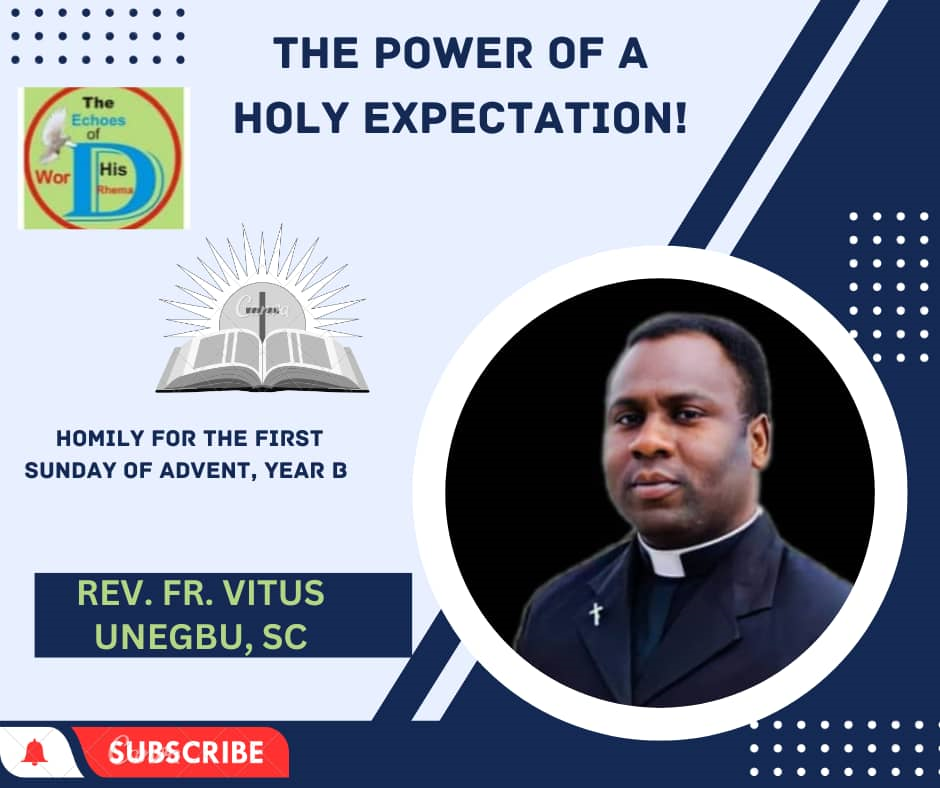
The Power Of A Holy Expectation!

 (Homily for the 1st Sunday of Advent Yr. B)

          Today marks the beginning of the liturgical period of Advent and the beginning of a new liturgical year. The word advent is from the Latin word “Adventus” which means “coming”, and it is a translation from the Greek word “parousia”. Therefore, it connotes expectancy and hope and at the same time points to the second coming of Christ. Hence, in our context, the time of advent is a time of great expectation for the coming of our Lord Jesus Christ amongst men, unlike in the ancient Greece it meant the coming of their god. The coming of Jesus can be understood in three senses: First, is His “coming” more than 2,000 years ago (that is, his Incarnation, that which inaugurated the messianic time of Salvation). Second, is His final and glorious coming at the end of time (the Parousia), and third, between His first coming and the final coming there is the intermediary Advent, His immanent and continuous coming into our lives. The Christian life is an ongoing advent, a constant personal encounter with Jesus who has come, who is to come and who is already in our midst.

          In the Advent spirituality Christ is always the One who is to come, the One who is always expected. Advent therefore, is not just a remembrance of a historical figure linked to a particular time and geographical location. It is not even an anticipated vision of the coming of the Just Judge. Rather the spirituality of Advent draws our attention to the urgency for the Lord to come into our lives with His grace and message of salvation. For Christ is the Living Lord, il Veniente, the One who comes. Be that as it may, we may begin our reflection with some fundamental questions: First, between the first and the final coming what sense has this our Advent? Second, if Christ is the One who always has to come, what then should be our attitude in view of His coming? In that bid, the readings of today are furnished with some insights and responses.

          The first reading (Is. 63:16b-17; 64:1.3b-8) from the Book of the Prophet Isaiah brings us face to face with a God who is Father and with the reality of our own sinfulness before Him. Isaiah is one of the Advent prophets, because he lived at a time of great longing for the coming of the Messiah and the restoration of God’s People. He presents a time when the exiles have returned from Babylon, and inspired by the Deutro-Isaiah’s prophecies, they had high hopes. But concretely they discovered that nothing seem to happen, they awaited restoration was not forthcoming. The people have begun to recognize that their exile was a consequence of their failure to live with integrity and in the ways of the Lord. Be that as it may, they burst into a lament of their situation: “Yahweh, can you restrain yourself at all this? Will you stay silent and afflict us beyond endurance?” (Is.64:11). In the midst of this reality that is still plunging them into despair, the prophet cried out to God for divine intervention: “Oh that you would come down, in your presence the mountains would quake” (Is. 64:2). As a matter of fact, at the heart of the spirituality of Advent is the human cry for divine intervention and manifestation. He acknowledges Israel's sinfulness and their need for 'the potter's hand' to refashion them into a faithful people they were meant to be. He uses the imagery of the potter and the clay, a significant reminder that we are in the hands of a God who loves us, ‘our Father and Redeemer’ (63:16b). We need this constant reminder that we are like clay in the Divine Potter’s hand, which goes a long way to revealing who and what we are before God (creatures, pardoned and redeemed sinners). Truly, Advent reminds us and brings to our consciousness the fatherhood of God.

          The prophetic prayer of Isaiah in verse 1 is powerful, praying for God in his might to tear the heaven and come down, this prayerful call for divine manifestation alludes or is connected with the Marcan account of the Baptism of Jesus (Mk. 1:10), when the heavens were opened, and God spoke. Indeed, the opening up of heaven is a mark of great divine intervention and manifestation. And without doubts, that was what Isaiah was asking for. In the spirituality of Advent, heaven is opened for the earth, God opened heaven and sent His Beloved Son. Behold, it is indeed plausible to launch us into the period of Advent with this divine invocation of “open heaven”, the Advent cry “Oh that thou should rend the heaven and come down”. And too the invocation to God to ‘return’ (Is.63:17b) is typical of Advent spirituality.

          The Gospel passage (Mk. 13:33-37) recounts the parable of the door keeper. Therein, Jesus announces to us the word at the heart of Advent: “watch”, he says take heed and watch, it is an attention of not only the mind, but the heart and the whole life.  There is a danger of being asleep, the problem for some of us is not just to watch, but to wake up, because we are sleeping Christians. Little wonder St. Paul warns, “brothers it is time to wake up from sleep” (Rm. 13:11). Mark’s account of this parable has some particular features, especially in comparison with the Lucan account (cf. Lk. 12:35-38). Some of the particularities of Mark includes the phrase: “a man going on a journey”, which was taken from the parable of the Talent. “Put his servants in charge, each with his work”, taken from the parable of the faithful and unfaithful servants (cf. Mt. 24:45; Lk. 12:42). The parable then ends with an exhortation “watch then, for you do not know when the master of the house is coming, whether in the first or the second or even in the third watch”.

          The passage begins with the imperative “Be on your guard” (v.33), “stay awake” (v.35), and “stay awake” (v.37). No one can calculate the precise kairotical moment (kairos) of the coming of the Lord, as such, from here springs the necessity for all to be awake for the eschatological moment that will mark the end of the world and the parousia of the glorious Christ. In that case, the “time” that is to come determines the reality of the present moment.

          In the context of the parable, the similitude therein is referred to the eschatological event of the parousia, which represents the full realization of the Kingdom. The servants that were given power, designate the disciples of Jesus. Here, while Mark speaks of the departure of the master who travelled abroad, Luke speaks of a nuptial banquet. In Mark’s account one discovers that verse (35) is replete with significance, for the master of the house is the Glorious Christ, the four chronological indications (evening, midnight, cockcrow or dawn) indicate the four broad division of the night in the Roman counting (from 6. pm to 6. am).

          In the last verse (37) we see how the teaching of Jesus Christ that was addressed to the four disciples, is now addressed to all the Christian community and to us today: “What I say to you, I say to all: stay awake”. In this passage, therefore, the imperative reminder: “stay awake” is very much expressive, for it condenses the essential meaning of the Marcan eschatological discourse. Existentially, all our Christian life consists and is geared towards a vigilant wait for the coming of the Lord, which is certain because it is founded on the unwavering words of the Lord, faith on the resurrection and on the different apparitions of Christ.

          In the second reading (1 Cor. 1:3-9) we see the opening blessing and thanksgiving of the letter, but from all indications it does appear that this is not the first letter of St. Paul to this community, for he writes in 1Cor. 5:9: “In my letter I wrote to you that you should have nothing to do with people living immoral lives”, thus, indicating a previous letter. However, that is not our interest! The thanksgiving that opens the letter is of a captatio benevolentiae. Therein, Paul thanks God for the various gifts that were made visible in the Corinthian community; he talked of their speech and knowledge. But one thing fascinating in the passage is Paul’s attempt to set the charismatic gifts in an eschatological context. He reminded them that irrespective of their gifts, they are still awaiting for the revealing of the Lord Jesus Christ. Indeed, St. Paul calls their attention for what lies ahead, for them not to be carried away by the gifts they had received. This reminder of St. Paul makes the second reading to dovetail into the message of Advent.

          Above all, we are called to be sentries, in view of the return of the Son of Man. Most importantly, let us hearken to appropriate the threefold guidelines of Jesus to us: Take heed! Watch! Pray! We need to activate the Advent mood and attitude. As we await the Savior who comes, it behooves us to reaffirm that our expectation is not like that of the people of Old Testament, because it is not only an expectation, but it is also memorial and presence. It is a memorial because the One we are awaiting has already come (this we remember at Christmas). It is presence because he is with us. His word we have heard is Himself with us, the Eucharist we celebrate is Himself with us. Interestingly, the most beautiful image of the Christian Advent is that of walking with joy to meet the One who is walking with us, who walks at our side. As suggestive of the theme of our reflection today, the time of Advent is not a time to wallow in idleness or to wait in inertia, rather the itinerary is waiting and walking. It comports a good dose of preparedness for the Coming and the Presence of the Lord. In Advent the search for God changes into the expectation of God, we live in anticipation of Him. And as we expect His coming into our lives, may we put our voices together to that of John in saying: “The one who attests these things says I am coming soon. Amen. Come Lord Jesus” (Rev. 22:20). Come for we are in need of YOU! Come and dissipate the darkness shrouding our World!!! Happy Advent Season Friends!!!

(Fr. Vitus M.C. Unegbu, SC)


Friday, 24 November 2023

Behold The Shepherd-King!

 (Homily for the Solemnity of Christ the King, Year A)

          Existentially speaking, today we live in hard and distressing times. We are confronted everyday with the discomforting news of terror, power tussle, political protests, kid-napping, injustice and the global nascent plight of migrants etc. Be that as it may, these experiences create fear and distrust in us. As such, every reasonable and God fearing individual is in search of and praying for a world where peace and justice reign. And we can only find that world in our Lord Jesus Christ, the King of the universe. Today we celebrate a King whose standard is love. The feast of Christ the King was introduced by Pope Pius XI in 1925, in order to confront the abuse of power by the nations and the surge of secularism among the nations and most importantly, to proclaim the primacy and supremacy of Christ over the kingdoms of the world. For as St. Paul would have it, “for in him were created all things in heaven and on earth; everything visible and everything invisible, thrones, ruling forces, sovereignties, powers -- all things were created through him and for him” (Col. 1:16).

          The Solemnity of Christ the King concludes the liturgical year and paves way for the Advent Season, which marks the beginning of another liturgical year of the Church. In every liturgical year, the mystery of Christ is always at the centre of our contemplation and reflection. In the course of the liturgical year, the Church, with the Sunday liturgical celebrations, celebrate and relive the history of our salvation, which has as its centre and culminating point the mystery of Christ. Most importantly, today the church presents the figure of Christ in his kingly dignity. Christ is the King of the universe, and the readings went a long way in helping us grasp the true meaning of his Kingship. Christ is a “Shepherd-King”, prophetically announced by prophet Ezekiel in the first reading. The Gospel presents him as the King and Judge of all nations and of each and every one of us. In the second reading instead, Christ’s reign seems to be of limited duration, for he reigns “until he has put all his enemies under hid feet”. The King, whose victory over death (the last enemy to be destroyed) manifests that he reigns. Today therefore, we celebrate a King whose kingdom is totally different from the kingdoms of the world. The Preface of the Mass puts it thus: “a Kingdom of truth and life, kingdom of holiness and grace, a Kingdom of justice, love and peace”. Kings come and go, likewise their kingdoms, but the kingship and the kingdom of Christ is eternal. The only Being who died more than 2000 years ago without RIP attached to his name, for he reigns for ever (cf. Ap. 1:17b-18a). St. Luke says: “his kingdom will have no end” (Lk. 1:33). Thus, the three readings of today delineated properly and in concrete terms too, the three aspects of Christ’s regality:

          The first reading (Ez. 14:11-12.15-17) provides an image of God leading His people with the care of a shepherd. The context is that of the Babylonian exile, when the earthly kings failed in their responsibilities. As such, the King-shepherd foretold by prophet Ezekiel is to replace the evil kings, who abusively exploited the flock. As a result, God henceforth takes over the task of shepherding his people (v.15). In the context of the passage, it is God Himself who vows to take personal responsibility for tending His sheep. The Lord himself goes to search for the lost sheep. St. John takes up this imagery in his Gospel, where he presents Christ as the Good Shepherd (Jn. 10:11.14). Thus, the kingship of Christ is to be understood in terms of a disinterested service, attention and care to the flock and total self-giving even to the extreme of his self-emptying that culminated on the cross. In verse 17 of the fourteenth chapter of the prophecy of Ezekiel, we see a remark denoting judgment, for the Shepherd will distinguish between sheep and goats, thus serving as a bridge between the first reading and the Gospel.

           The passage of today’s Gospel (Mt. 25: 31-46) is often identified as the parable of the sheep and the goat or of the final universal Judgment. The passage presents Christ’s kingship as an act of judgment. Therein, Jesus appears as a supreme Judge of the universe, because the Father has given every power to Him. Frankly speaking, the scene of today’s Gospel can easily instil fear in us, because of Christ’s severity at Judgment. In this stupendous page on the final judgment, St. Mathew presents Jesus as King of the universe, and he was constituted as the supreme judge by God. In that final judgment, the yardstick for measuring our actions will be basically love, love of neighbour, exemplified in the exercise of corporal works of mercy: feeding the hungry, giving drink to the thirsty, welcoming strangers, clothing the naked, visiting the sick and visiting the imprisoned. Jesus will judge us based on our treatment of him in our fellow human beings. For the standard of judgement on the last day is hidden in the following words: “Truly I say to you, as you did it to one of the least of these my brethren, you did it to me” (Mt 25:40). At this point Jesus presents a sublime Christology in anthropological terms, for whatever is done to the least of the brothers is done to Christ. Jesus established a strong affiliation with the least in our midst, to the point of identifying himself with them.

          In identifying himself with the least of his brothers, to reward those that recognized him in the poor, Jesus said “Come, O blessed of my Father, inherit the kingdom prepared for you from the foundation of the world; for I was hungry…, I was thirsty…, I was naked…” (Mt. 25:35-36). The list could still continue on and on: I was an unborn baby, and you welcomed me by allowing me to be born. I was an abandoned child, and you made me part of your family. I was an orphan, and you adopted me and raised me as one of your own children. As a matter of fact, this emblematic passage shows us not what will happen on the last day, but it reminds us of what we ought to do as we live. We will be judged on the basis of our love of neighbour, motivated by our love for God. In the words of St. John of the Cross, “In the evening of life, we will be judged on love alone”, not on devotion and religious attendance.

          Thus, the Gospel tells us what we need to do to be part of this Kingdom: feed the hungry, give drink to the thirsty, welcome the stranger, clothe the naked, care for the sick and visit those in prison. Those who are practicing these things are part of a kingdom that God himself has prepared “from the foundation of the world” (Mt 25:34). Drawing the point further, celebrating the Solemnity of Christ the King implies that we have accepted Christ as the King of our life, and that we are ready to let him reign in our hearts, that we are ready to follow him in the humble service of our brothers, “the little ones”, that we are ready through our actions to expand the kingdom of Christ to all the corners of the earth. The parable teaches us that sin does not only consist in the bad things we do, but also in the good things we should have done, but we did not do, that is the sin of omission.

          In the second reading (1Cor.15:20-26.28) St. Paul reminded the Christians of Corinth of the fact of the resurrection from the dead, pointing succinctly to the death and resurrection of Christ. Through his resurrection Christ destroyed death and restored life. St. Paul affirms Christ’s regality and opines that Jesus Christ is our King, the King of the Universe, because he won victory over death and He is the Lord of life. In his words: “Christ has been raised from the dead as the first fruit of all who have fallen asleep” (v.20). His victory over death has made us participants to his kingly dignity and liberty. Be that as it may, those who belong to Christ will form part of his Kingdom. In this Kingdom all will be subject to Christ the King. St. Paul presents the reign of Christ as the absolute reign, to which every other must give way, “For he is to be king until he has made his enemies his footstool, and the last of the enemies to be destroyed is death” (vv.25-26). However, He has overcome death because he has deprived it of its meaning as the total destruction of man, he transformed it into a new birth leading to eternal life. Above all, as we have earlier opined, Christ’s reign seems to be of limited duration. How? For he reigns “until…” (1Cor. 15:25). But that is not all, the fascinating thing is that it is to be replaced by the Kingdom of God (Father) himself when Christ delivers the kingdom to the Father (cf. 1Cor.15: 24). Jesus says: “The Father and I are one” (Jn. 10:30), so there is going to be the continuation of the same Kingdom. Though, it has to be clarified that the word “until” does not signify termination in toto, but that of his mediatory kingdom on earth (cf. Ps.110:1), for according to O. Cullmann “the kingly rule of Christ and the church completely coincide”.

          The kingship of Christ is completely different from that of the world. He responds categorically to Pilate, “Yes, I am a King” (Jn.18:37), but he already affirmed: “my kingdom is not of this world” (Jn.18:36), that is why his Kingdom is universal, inclusive and eternal. Therefore, his kingdom does not consist in the dominion of peoples, nor in the possession of territories etc. Instead, the kingdom of Christ, as we proclaimed in the preface of the Mass: “is a kingdom of truth, and life, kingdom of holiness and grace, of justice, of love and of peace”, these are the characteristics of God’s kingdom.

           Beloved in Christ, this kingdom comports an existential implication for us, because we do not only celebrate the King of the Universe, but also our membership in this kingdom. For this St. Peter called us “kingly people” (1Pt. 2:9). In the words of St. Paul “It is he who has rescued us from the ruling force of darkness and transferred us to the kingdom of the Son that he loves” (Col. 1:13), ours is a gratuitous transfer to this Kingdom, but do we really belong to this Kingdom? Today, the hot button questions we have to ask ourselves are: Is Christ really our or my King?  What or who is ruling in my life? Christ is our King when his words and examples have become norms for our actions (cf. Ps. 128:1; Jn.4:34). Today’s feast should not only end with mere and empty proclamations and gyrations, we have to allow the Truth to lead us. We belong to his kingdom when we live according to his words (cf. Jm. 1:21-23). His is a kingdom of truth and love. Do we bear witness to his truth and to his love? We belong to his kingdom when we live in truth, grace, holiness, Justice, love and peace. Which kingdom do you belong?

          Let us march out to tell the whole world that we have a King, who is also our shepherd. Let us proclaim and acclaim him King, let us confess and profess that He ALONE is our King. We are therefore challenged to allow Him to be the Ultimate King in our lives. It is not untrue that most of us have various kings and kingdoms that are ruling and occupying our lives. We need to stop a while and ask ourselves who is actually ruling in my life? Child of God allow Jesus to reign in your life.  Let us in one chorus put our voices together to that of the Psalmist in declaring the smooth entrance of this King: “Lift high your heads, o ye gates! Lift up, you everlasting doors! Let him enter the King of glory”. Who is the king of glory? The Lord of Host, He is the King of glory” (Ps. 24: 9-10). Lift those things in your life that may block His entrance, lift those things that may obstacle his entrance into your family, lift those ancient ways of living, those ancient gods. Let us open up for him too. Let us open our lives, our families, our societies, our educational system, our political system, our work place, our dreams and aspirations, so that He can enter and take control. For wherever he enters, witnesses a change. Welcome Him today, so that he may recognize you as sheep and not as goat on the day of reckoning. Let Him enter the King of Glory (cf. Ps. 24:10), Our Peculiar King, for no one is like you (cf. Ex. 15:11), God made King, for royal dignity has been yours from birth (cf. Ps. 110:3; Jn. 18:37), King with divine mandate (cf. Dn. 7:14a), King of Kings (cf. Rev. 17:14; 19:16), King of the whole world (cf. Zech. 14:9), King of peace (cf. Is. 9:6), The highest King (cf. Rev. 1:5), Everlasting King (cf. Jer. 10:10; Lk. 1:33). Have a wonderful celebration of Christ the King, not just today but every moment of your life. May Jesus come to reign in our hearts and turn our hearts to His Throne! Amen!!!

(Fr. Vitus M.C. Unegbu, SC)

Be Fruitful! Bloom Where God Has Planted You!

(Homily for the 27 th Sunday in Ordinary Time, Year A)      The unprecedented message of today revolves around the parable of rejected lo...