Monday, 14 August 2023

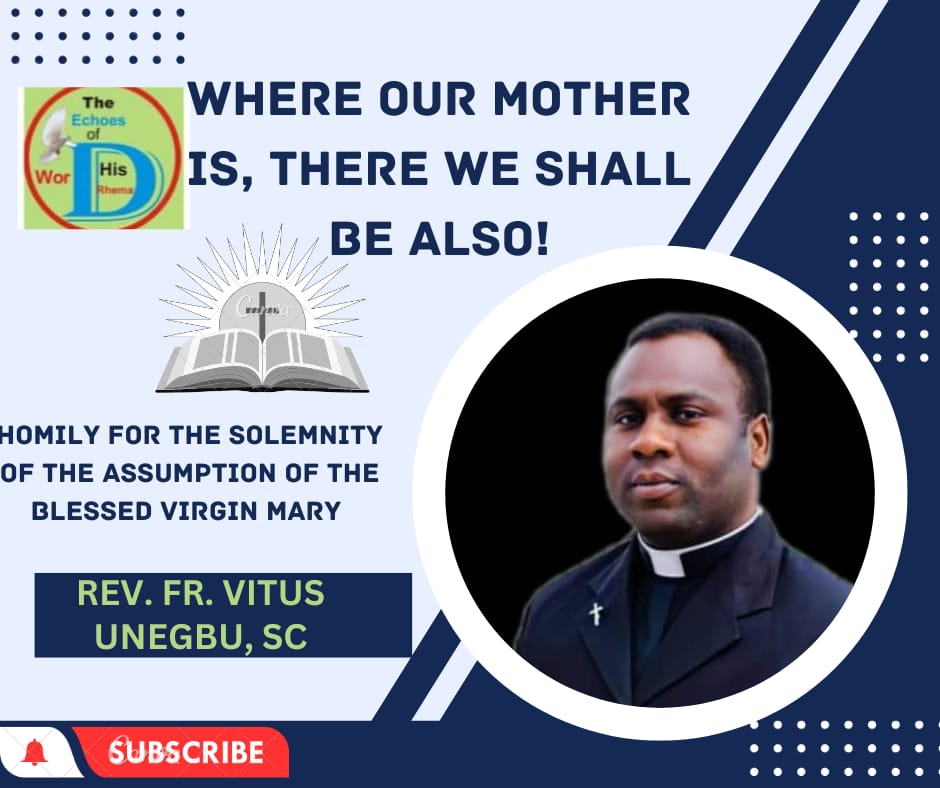
Where Our Mother Is, There We Shall Be Also!

(Homily for the Solemnity of the Assumption of the Blessed Virgin Mary)
     Today we celebrate the Solemnity of the Assumption of the Blessed Virgin Mary, the taking up of the body and soul of Mary, by God into heaven. Indeed, at the heart of this event is the reminder that her Assumption does not mean that she has gone away or deserted us, rather that from heaven she assists the Church in her trials and consoles her in pains. She is still very much involved in our struggle against evil. Again, her Assumption vivifies our hope, for where our Mother is, there we shall be also. The pivot around which revolves the readings of today is the concept of “relation”, and it is orchestrated in the rapport between Mary and God, Mary and her Son and Mary and the Church. Mary’s greatness and favor springs from her relation with God. She is a woman of prevenient and enabling grace. In the Gospel we see the relation of Mary with God the Father: “He who is Mighty has done great things for me”. In the second reading we can see the relation between Mary and the Son, Jesus: “the first fruit of those who have fallen asleep”. On the other hand, the first reading presents the relation between Mary and the Church: “a woman clothed with the sun, with the moon under her feet, and on her head a crown of twelve stars”, God’s warrior Queen!

       The gesture of Mary in today’s Gospel (Lk. 1:39-56) is not just an act of courtesy, but of love: “She went in a haste.” She visited Elizabeth, who was expecting a child (John the Baptist), and she stayed with her for three months, to be with her and to help her with the domestic chores. This visit of Mary to her was an episode replete with joy and exultation. As we were told, that as soon as she arrived the baby in Elizabeth’s womb leapt for joy. At that time Mary has already conceived Jesus and Elizabeth felt the presence and was sanctified. Elizabeth was illuminated by the Holy Spirit and she exclaimed: “Blessed are you of all women, and blessed is the fruit of your womb” (v.42). This expression is a compendium of the greatness of the Blessed Mother. Three times in this passage Mary is pronounced “blessed”, as a matter of fact, the second verse of the Magnificat is the scriptural ground for calling her the Blessed Virgin. And again two closely related reasons are given for the title “blessed” that Elizabeth gave to her: because of Mary’s faith (v.45) which is related to her obedience (Lk. 1:38) and the bearing of the Child Jesus (v.42). Be that as it may, Mary is blessed not based on who she was or is in herself, rather she is proclaimed blessed in relation with her obedience to the Incarnation event. Her importance is incumbent upon her faith and obedience which made the Incarnation humanly possible, and more still because she gave birth to the Child of Bethlehem, the Messiah.    

     On the other hand, Mary too exults with the canticle of magnificat, a hymn of praise and of gratitude to God for the wonders He has wrought. There, the presence of Jesus is a fount of joy for all, especially those who open their hearts to him (just as it was in the case of Elizabeth and Mary, even for John too). On the other hand, this passage falls within the visitation narrative and the Magnificat. The Magnificat is to be seen not as an individual hymn of Mary, but as the hymn of the representative of the true Israel, and this is indicated by the switch from the first person singular to the third person plural (cf. v.50). Mary indeed is the symbol of the true Israel that rejoices in the Lord for the coming of the Messiah.

      In this passage we see Mary in relation to the Father. She recognized that the Father has done great things for her, what are those great things? ●First is the fullness of grace with which she was conceived, her Immaculate Conception, which accompanied her in the course of her earthly existence. ●Second is the mystery of her divine maternity, the Only Son of the Father took flesh from the Blessed Virgin Mary. This indeed is a wonderful gesture of the Father’s love towards Mary and all humanity. God made her the arch of the new covenant, with God in her womb she was a cause of blessing for John the Baptist and his fathers (cf. 2Sam. 6). The great things God has done in the life of Mary do not end with the birth of Jesus; for God continues to work his greatness in the heart and life of Mary. ●And the last of these great things is the assumption in body and soul to the heavenly glory. Mary was possessed by grace in body and soul, the Immaculate in whom there is no iota of corruption, because everything in her life is grace, pure grace of God.

      The second reading (1Cor. 15: 20-26) presents Mary in relation to the Son, Jesus. The mystery of the resurrection of Jesus Christ and of his consequent glorification is unimaginable without the reality of a body, formed in the womb of the Virgin Mary. Christ has broken the bondage of death and became the first fruits of the dead. The Blessed Mother can look at Jesus and say: “This is the flesh of my flesh”. If therefore, the body of the Son was glorified, is there any doubt that the Son will indeed glorify the body of her mother, the blessed flesh that was at the same time arch and nourishment for him. The risen Christ is the first fruit of those who have fallen asleep, in the temple of Jerusalem, the feast of first fruits pre-announces the abundant harvest, now, the glorified Christ pre-announces the glorification of the all the believers. It is a glorification that will take place in his second coming at the end of time. The definitive Easter of every Christian is not possessed, rather it is a certain and sure hope. Mary is the only woman who already lives in the definitive Easter, because in her blessed flesh, her Son Jesus Christ realized in fullness the work of redemption. In a certain sense, we can affirm that Mary together with Jesus, through his works, are the first fruits of those who have fallen asleep. As such, we cannot but raise our gaze to Mary Assumed into heaven with love and hope.

     The first reading (Ap 11: 19; 12: 1-6a.10ab) instead presents Mary in relation to the Church, the woman presented in the book of Revelation symbolizes Eve, Israel and the Church. In the passage the child that is born is the Messiah, for in verse 5: “the son who was to rule all the nations with an iron scepter”, these messianic qualities were attributed to him as in Psalm 2:9, and again fostered by the proclamation that follows his exaltation to God’s throne. Thus, there is a question that arises from this passage: who is the woman that is described in this passage? There are three possibilities as regards the identity of the woman in question: ●Some regard her as the representation of the old Israel, the nation from which the Messiah came, this is a suggestion of the Old Testament literature (cf. Is. 66:7). ●Secondly, she is seen as the image of the Church, the new Israel, the mother of the faithful, it alludes to Rev. 12:17 that talks about the other children belonging to the woman. ●Thirdly, as a fruit of recent catholic exegesis, the woman is identified as the Blessed Virgin Mary. Indeed, of these three interpretations it does appear they all converge into the image of Mary, the daughter of Zion, an iconic expression of the old Israel as well as the new Israel. The dragon is the old serpent that tempted Eve, and made her to be sent away from Paradise (cf. Gen. 3). However, in the passage of our second reading in verse 15 there come rays of hope, with the woman that conquered the serpent, marching on its head. This woman is the new Eve, Mary, on whom the serpent had no power, and for this she can with total freedom obtain the victory on the serpent. The woman represents the people of Israel, the woman-spouse with whom God contracted spousal covenant, a woman beautiful like the sun, powerful as a great queen, in expectation of a baby. In the person of Mary, the vocation and the hope of Israel is realized in a perfect way. She is beautified with divine splendour, powerful for her humility, in expectation, for she carries in her womb the Son of the Most High. She is also the symbol of the Church, the Church in the splendour of her sanctity, in her fecund maternity, in the situation of persecution for the work of the Devil, in the desert to regain power and to prepare for battle of victory. Mary as the daughter of the Church brought even to God her sanctity, her fecundity, her victory; as the mother of the Church, from heaven she assists the Church in her trials and consoles her in pains.

     In all, the Assumption of Mary is a guarantee of our hope. The glorious destiny of Mary is our last and definitive destiny as well. Her glorious presence in heaven does not only reveal the privilege of Mary, but also of the call of God towards all to participate in this same life in fullness. Where our Mother is, there we shall be also! May Our Blessed Mother Mary the Bright Morning Star continue to intercede for us in our earthly sojourn towards our Promise Land. Amen!!!

(Fr. Vitus M.C. Unegbu, SC)

Friday, 11 August 2023

Trusting In God Without Ifs And Buts!

(Homily 19th Sunday in Ordinary Time Yr-A)

    The great message of today’s liturgy hinges on God’s revelation and the human response towards it.  In the first reading (1Kgs. 19:9.11-13) God revealed himself to Elijah with the soft breeze on Mount Horeb. And in the Gospel narrative (Mt. 14:22-33) Jesus revealed himself to the disciples as the Son of God through his dominion over the waters of the agitated sea and through his mysterious words: “It is I, do not be afraid”. St. Paul on his part in the second reading (Rm. 9:1-5) was very much aware that God has revealed himself to the people of Israel: “to them belong adoption as sons, the glorious presence of God, the covenant, the law, the cult and the promise” (Rm. 9:4). On the other hand, divine revelation requires a human response. Thus, the response of Elijah before the presence of God was that of Holy fear: “He covered his face with his mantle” (1Kg. 19:13) and obedience of faith. That of Peter instead was of fear and doubt: “man of little faith, because you have doubted” (Mt. 14:31), instead that of the rest of the disciples was of faith: “truly, you are the Son of God” (Mt. 14:33). In the second reading, St. Paul manifested his sadness on the people of Israel who responded by refusing the revelation of Jesus and his divine filiation. What is your own response? Man’s response as we have seen varies: it can be that of acceptance, rejection, disinterest or indifference.  But above all, the thrilling message of today is for us to trust in God at all times even in dark moments of our life. He is the I AM, His voice continues to re-echo in the various situations of our earthly existence: “It is I, do not be afraid”.

     In the first reading (1Kgs. 19:9.11-13) God revealed himself to man not through concepts, but through symbolic actions and rapport. To Elijah that ran away from Mount Carmel in order not to be assassinated by Jezebel (1Kg. 19:1-3), God made him to pass through Palestine from North to South, in order to take him to Mount Horeb, the Holy Mountain of God, mount of divine revelation. Elijah prayed to God thus: "Lord, I have had enough. Take away my life." But after this Horeb encounter, his prayer changed: "I am filled with jealous zeal for the Lord of hosts”. In the spiritual context of the mountain, in solitude and prayer, God revealed himself to Elijah. To Moses, he revealed himself through lightening, fire and sounds (cf. Ex. 19:16-19). Here, he will reveal himself to Elijah through a gentle breeze. In this episode Elijah felt isolated and undefended, and he was afraid of the power and cruelty of Jezebel who was persecuting him. As he was perturbed about how Jezebel is going to triumph over him, suddenly there came the gentle breeze, a sign of the invisible but real presence and action of God. Elijah did not feel lonely again, despite all, he understood that in Israel there are still many faithful people. It was indeed a moment of encounter, Elijah encountered the Lord in “a light murmuring sound”, after hurricane, earthquake and fire the Lord comes in a light murmuring sound of a gentle breeze. Elijah covered his face to adore Him. We see a similar gesture at the end of the Gospel, where the men in the boat bowed down before Jesus saying: “Truly, you are the Son of God”. We too are to be part of this adoration. We are no longer to cover our faces but to recognize his presence and power at work in and for us. The similar experience of fear and doubt of Peter in the Gospel, was experienced also by Elijah, who in that famous theophany on Mount Horeb, was perturbed and afraid of how he is going to escape the wrought of queen Jezebel. But the Lord assured him, that He will intervene in his favour and the prophet reacquired trust and courage. Thus, it is an invitation for us to trust firmly in God and not to panic even in the face of life challenges.

     In today’s Gospel (Mt. 14:22-33) we see an important element: Prayer. After the miracle of the multiplication of bread and fish, Jesus rejected triumphalism for He sent the crowds away and went to the hills to pray. Jesus passed through long hours of Prayer, in dialogue with the Father (cf. Mt.14:23), while the disciples were helpless before the waves. Suddenly, they saw a human figure coming towards them and they thought it was a ghost. Jesus took advantage of this circumstance to reveal to them his most intimate identity, through a symbolic gesture; as Yahweh in the Old Testament (cf. Jb. 9:8; Ps. 77:19), he walked on the water, demonstrating that he is the Lord of the Sea and of Nature. When Jesus came across the water and saw his disciples plunged into fear, he said to them: “Courage! It is I. Do not be afraid”. With these words Christ revealed and identified himself as God. He is the “I am”. He is saying I am God, fear not. He revealed to his disciples his divine Name: “I am”. Like Yahweh to Moses (cf. Ex. 3:15). Jesus shows his disciples his divine power, but especially, he revealed his divine filiation, as the Son of God. In this Gospel narrative according to Mathew, we see a number of movements and events that seem to take place in just a short period of time: Jesus made his disciples get into the boat, he told them to go ahead of him to the other side, then He sent the crowds away and went to the hills to pray. Then, in the night when the disciples were facing rough waves, He walked on the sea; he calmed the wind and saved Peter as well.

     This passage therefore can be presented in three perspectives or better put; it can be interpreted under three different dimensions. ●First, the Christological dimension, in this passage the figure of Christ is predominant. Jesus revealed himself in his majesty, power and dominion over the forces of nature. At the end, those in the boat exclaimed: “You are truly the Son of God”. ●Second, the Ecclesiological dimension that is with reference to the Church. Indeed, here the figure of Peter is different from others, and it indicates his function of primacy among the apostles and in the Church. The boat pressed hard by the waves represents the Church, who encounters the first difficulties, external persecutions and internal tensions. In fact, along history lane, we see how the Church suffered from one persecution to the other. This has been the history of the Church, even as revealed in some pages of the New Testament. St. Peter in his letter addressed the Christians in the following words: “My dear friends, do not be taken aback at the testing by fire which is taking place among you, as though something strange were happening to you” (1Pt. 4:12) and again: “Stand up to him, strong in faith and in the knowledge that it is the same kind of suffering that the community of your brothers throughout the world is undergoing” (1Pt. 5:9). But Jesus is with the Church and He has dominion over all the adverse powers threatening the Church. ●Third, is the Spiritual dimension, it is with reference to our personal experience. In our spiritual experience sometimes we are like a boat that encounters contrary winds and waves and thus finds it difficult to move on, and risks sinking. In fact, everyone in one way or another encounters difficulties, delusions and bitterness, many a times we find ourselves in the shoes of Peter. Sometimes like Peter we seem to bubble in our faith and it does appear we can give our life for Him, but some other times, we are taken by doubts and fear, and we enter into crises. How many times, have we merited the reproach of Peter: “Man of little faith, why did you doubt? But in all this, Jesus in his love and kindness continues to stretch out his hand towards us. He intervenes so that we do not sink. He restores our trust.

     Jesus called him “man of little faith”, Peter in this episode represents every one of us. With his instinctive impulse, without giving it a second thought, he said to Jesus, “Lord, if it is you, tell me to come to you across the water”, in fact, he already doubted Jesus. Just as it happens to us many a times, when we face trials we begin to doubt God, his existence and his goodness, and doubting we sink the more. Peter without much hesitation left the boat and jumped into the sea to walk. According to Dietrich Bonhoeffer Peter had to leave the boat and risk his life in order to learn perhaps the most valuable lesson and straightest path in the spiritual journey: the realization of both his own weakness and omnipotence of Jesus. But also, Peter teaches us how to come out of every situation, no matter how difficult, he cried: “Lord save me”. And immediately Jesus extended his hand to him, He held him and said man of little faith, why do you doubt? Indeed, prayer is like the cry of the soul that places all its trust in God. No matter what you are passing through today call on Him, just as Peter did. We should long to hear those wonderful words of Jesus: “Courage, it’s me, do not be afraid”.

     Behold, in situations of anguish and panic, whenever this passage of Mathew’s Gospel is proclaimed, we draw some inferences of certainty of trust: that the Master is not far from us, He will not leave us alone to combat with the waves and the wind, we only need to invoke Him and He will come to our aid. Indeed, this trust is founded on the certainty that He is risen and he lives (cf. Rev. 1:17-18). There is an important element emanating from this passage and it is derived from the words of Jesus to Peter: “Courage! It’s me! Don’t be afraid” (v.27) and Peter answered “Lord, he said, if it is you, tell me to come to you across the water” (v.28). We should never lose sight of the presence of God or let our trust in the Lord waver, even in moments of difficulties and challenges. It is an invitation therefore, to us, not to fix our gaze up or down on the rough waves we might be experiencing in various situations of our life, rather to have our gaze fixed on Jesus. If you remove your gaze from Him you sink. Peter almost suffered near-success syndrome. For when Jesus came at the scene of the waves He calmed the waves and Peter now out of his impulsive character doubted Jesus. Jesus granted him to walk on the water, He started well but on noticing the wind he became afraid and began to sink almost at the verge of the completion of his own miracle. Many of us are like Peter, we begin our projects, businesses, life endeavours, and spiritual undertakings well but hardly arrive at the desired aim. Let us pray therefore against every spirit of near success syndrome. So that God’s purpose in our life will be accomplished.

    In that episode, we are told that Jesus came towards them at the fourth watch of the night, that’s towards the end of the night, he did not come before, he came when they were at the peak of the trial and were very tired too, when it does appear they have to resolve everything solely with their own power, in the absence, distance and silence of the Master. But the Master was thinking of them, in fact he was coming towards them, for he was aware of their difficulties. Similarly, in our own experiences of the apparent distance and silence of God, in the darkness of our own night, he is very close to us. But it is important that we implore him, just as Mark reported in his Gospel when Jesus was apparently sleeping during the storm: “Master, do you not care? We are lost” (Mk. 4:38). Today we are called to recognize His presence. Thus, it is an invitation for us to remain in the boat and proclaim together with the apostles the faith that saves. Till today, Jesus is still the question-raiser. "What sort of man is this?" (Mt. 8:27), "Can this be the son of David?" (Mt. 12:23). The impact of meeting Jesus, the moment He joined them in the boat stimulated the disciples to make a full confession of Christian faith. Just as Mathew reported: “The men in the boat bowed down before him and said: Truly, you are the Son of God” (Mt. 14:33).

          In the second reading (Rm. 9:1-5) St. Paul reminds us of the extraordinary prerogative of the Israelites before God, he underlined that “his were the patriarchs and from them as man, Christ came” (Rm. 9:5). With the patriarchs the historical revelation of God began, and with Christ the revelation reached its culminating point, and fullness. God revealed himself as the Faithful per excellence, who does not regret of his choice or of his promises to the chosen people. Little wonder, the covenant of God with the Israelites remains, irrespective of their infidelity. But the emotion of Paul here is similar to that of Elijah in the first reading. Paul too, was having in his heart great bitterness, his co-Jews, anyway, many of them rejected Jesus and now they are rejecting his Church. He expressed his bitterness, for after his effort of bringing his fellow Jews to Jesus Christ, the result was very much disappointing and he never failed remarking the fault of Israel. Irrespective of the disappointments and delusions he never stopped loving his people, to the point of declaring himself ready for all things, even to save them.

      In all, the story of Elijah in the first reading teaches us never to give up on God, because He does not give up on us. Similarly, in the episode of the Gospel at the outset of the story when the disciples were facing the waves they were terribly afraid but Jesus comes to their rescue. One can imagine how reassuring those words (Courage, it is I. Do not be afraid) of Jesus were to them. Above all else, the message for us today is quite clear: when fears and problems assail us, when God seems to be remote, afar, and forgetful of our plight and challenges, we should learn how to prayerful shout: “Lord save us”! And may He save us from all challenges, from every near-death experience and from near success-syndrome. Today more than ever, just as Jesus did at the beginning of the Gospel we need to create space for prayer and silence, oasis of meditation and moments of interior tranquillity. For it is in such atmosphere that the presence of the Lord is made manifest. God is never late. May the Lord always be punctual at our points of need, at that moment we think all is lost, may He appear and speak to us: “Courage, it is I, do not be afraid.” God speaks and he is speaking to you with the words of the Psalmist: “Be still and acknowledge that I am God supreme over the nations, supreme over the world” (Ps. 46:10). Amen!!!

(Fr. Vitus M.C. Unegbu, SC)

Friday, 4 August 2023

Transfiguration: Jesus Glowing In Glory!

(Feast of the Transfiguration of the Lord Yr. A)

     Today we celebrate the feast of the Transfiguration of Jesus. Today’s celebration marks a crucial moment in the earthly ministry of Christ: the manifestation of His radiant glory to his three privileged apostles: Peter, James, and John in the presence of the Old Testament figures: Moses and Elijah. According to the Catechism of the Catholic Church, “Christ’s Transfiguration aims at strengthening the apostles’ faith in anticipation of his Passion: the ascent onto the ‘high mountain’ prepares for the ascent to Calvary” (CCC 568). Indeed, the event of the Transfiguration reveals partly the true identity of Jesus, when the veil covering his identity was uncovered for his disciples to have a glimpse of Him and His glory. This was just a vision, but the real drama that will unfold his full identity will come at the Mount of Calvary. Jesus took three of his apostles to Mount Tabor and revealed himself to them in a unique and divine experience, his Mission as New Moses, New Elijah and the Son of God.

     The first reading (Dan. 7:9-10, 13-14) from the prophecy of Daniel introduces us to the event of the Transfiguration. This passage with the visions of Daniel pre-empts the episode of the Gospel. Therein, we see the nocturnal visions of Prophet Daniel. Daniel in the period of tribulation and exile saw through the darkness of tribulation, a history, salvation, he saw the work of God and God Himself, who mounts His throne. He saw open books, which denote a plan, a project of God, he saw something that the Israelites could not see at that time. The prophet saw beyond the reality. And this “seeing beyond” serves as the interpretative key to the Feast we are celebrating today. Besides, at the heart of the vision of Prophet Daniel is the Son of man who comes on the clouds and his sovereignty and kingship. He narrated that people from all walks of life serve him and that his kingdom is an everlasting kingdom, such indeed is the kingdom of our God! Daniel’s vision of the son of man coming on the cloud prefigures Jesus whose identity was revealed by the voice of the Father from the cloud.

     The Gospel passage (Mt. 17:1-9) presents the event of Jesus’ transfiguration. Jesus took three of his apostles to Mount Tabor and revealed himself to them in a unique and divine experience, his Mission as New Moses, New Elijah and the Son of God. He is the fulfilment of both the law and the prophets. The transfiguration looks backward and forward; it looks backwards to the origin and real identity of Jesus, and looks forward in anticipation to the Passion and subsequent glorification of Jesus at the Resurrection event. St. Mathew situates the event of the Transfiguration in the part of his Gospel where he speaks about the revelation of the Messiah (13:53-17:27); the solemn proclamation by Peter: “You are the Christ, the Son of the living God” (16:13-20) and lastly after the proclamation of the Passion (16:21-28).

     The word transfiguration simply means change of figure or the change of form. But transfiguration as in the event of Jesus is more than mere change of figure. Symbolically, it is an anticipation of the resurrection. Although, in Greek the word “metamórphosi” which is translated as transfiguration, indicates something more than a change of figure, it means to go beyond the form, it entails the revelation of what was hidden. Thus, his transfiguration meant the revelation of the hidden form, figure and identity of Jesus. It went beyond the perception of Jesus as just Man, instead therein, He was revealed as True God and True Man. In the Transfiguration of Jesus we see rays of Jesus’ divinity, which was somewhat hidden by his humanity, he offered us an anticipation of his future glorification and demonstration that his death on Calvary will not be the end, there is the resurrection, and death will not have the final word!

     As a matter of fact, the overriding question that readily comes to mind after reading this passage of the Gospel is: why were only these three Apostles chosen to be present? Why not all of the Twelve or even a larger group of the disciples? For if it is for strengthening of faith, every disciple of Christ needed that, before witnessing the great trial of the Lord’s Passion and Death. The Fathers of the Church too, reflected over this question, and after his reflections St. John Damascene opined that St. Peter was chosen in order “to show him that the testimony which he had borne was confirmed by the testimony of the Father; and because he was about to become the president of the whole Church.” (Cf. Homily on the Transfiguration). St. John Damascene equally reasoned that the presence of James owes to the fact that he would be the first of the apostles to die as a martyr (cf. Acts 12:2). Therefore, St. James in a sense represented the apostles who were not present for the Transfiguration. And lastly, St. John Damascene maintains that St. John was present because “he was, as it were, the most pure instrument of theology, that beholding the glory of the Son of God, which is not subject to time, he might declare, In the beginning was the Word.” (Cf. Homily on the Transfiguration). Indeed, those words, begin the prologue of St. John’s Gospel. The prologue culminates in the words: “And the Word became flesh and made his dwelling among us, and we saw his glory, the glory as of the Father’s only Son, full of grace and truth” (Jn. 1:14). Some exegetes interpret this mention of Christ’s glory as a reference to the Transfiguration that the Beloved Apostle John experienced. As a matter of fact, after their experiences of fear and uncertainty, Christ gave to those three privileged apostles the grace of witnessing the Transfiguration not only to strengthen their own faith, but also to prepare them to preach that faith to the world. Little wonder, as they descended the mountain Jesus told them: “Do not tell the vision to anyone until the Son of Man has been raised from the dead.” (Mt 17:9).

        In his narrative, Mathew provides a number of fascinating factors: ●Mathew and Luke unlike Mark mentioned about the change of Jesus’ face and countenance respectively, “his face shone like the sun” (v.2). ●Only Mathew compared the whiteness of Jesus’ garments to light (v.2). The splendour of his face and the whiteness of the garments indicate the glory of God manifested in Jesus. ●Moses and Elijah are the two of the most important figures in the Old Testament, Moses represents the law that Jesus has come to bring to fulfilment, while Elijah represents the prophecies that Jesus has come to realize. He is therefore the Promised Messiah. Jesus is the New legislator who will give men a unique commandment and the synthesis of all other commandments: love, and as the new prophet who will proclaim to men the secrets of the heart of his Father. Thus as the new Moses and new Elijah he will realize his vocation and manifest the love of the Father. ●What was the content of his discussion with Moses and Elijah? Only St. Luke opined that Moses and Elijah were speaking “of his exodus, which he was to accomplish in Jerusalem” (Lk. 9:31), that is, his Passion. ●Mathew like the other synoptic reported the voice that came from the cloud saying: “This is my beloved Son, with whom I am well pleased, listen to him.” The content of the message of the voice of the Father is a revelation that in terms of what Jesus does (his works) he can be compared to Moses and Elijah, but at the level of being he is more than them, because he is the Son of God! Secondly, we are all invited to listen to him, listening to him entails following his examples and threading the paths he has charted for us. The voice of the Father from the clouds reveals who Jesus is: “This is my Son.” God the Father reveals that Jesus is not only a man, He is also God. The context of the transfiguration event is a place where God declared the identity of the Son: “This is my beloved Son, listen to him”. After the Father’s voice, Jesus readily climbed down from the mountain of glory to the valley of human predicament and suffering. While he was coming down from the mountain Jesus ordered his disciples not to talk about the transfiguration until after his resurrection. ●In Mathew, there was a command of silence until after the resurrection. Mathew reported this command, Mark said: ‘he charged them”, but Luke omitted it. Why this command? It is because it will lack logicality, if the transfiguration is disclosed before the death and resurrection that would imply glory without the cross. At the heart of this narrative therefore, is the age-long assertion: “No cross, no crown”.

        Indeed, let us imagine the scenario at Tabor, before the apostles: Peter, James and John, and the vision of the transfigured Lord. It was indeed an atmosphere of bliss and indescribable joy that made them to be bewildered and overwhelmed. They saw the resplendent glory that effused from Jesus. Then out of bewilderment and fear, Peter spoke up: “It is wonderful for us to be here.” They wanted to remain there. Peter went as far as coming up with a concrete proposal on how to realize that dream or project: “I will make three booths.” At the heart of that event, Mathew tells us that the disciples were afraid, and Jesus intervened and calmed their fear with his reassuring touch and voice. As a matter fact, the Scriptures portray fear as man’s reaction to a theophany. “When I saw him, I fell at his feet as though dead, but he laid his right hand on me and said, Do not be afraid…” (Rev. 1:17). And this fear was conquered only by the encouraging word of Jesus (cf. Mt. 14:27; 28:5, 10). Jesus came and touched them, saying; “Rise, and have no fear”, and they began to walk down to plain ground. There is a human tendency to remain in a place considered to be a comfort zone, just like the three apostles, even though they were afraid, but the mountain at that point became a comfort zone and they wanted to remain there to enjoy the tranquillity of the mountain and the “divine display”. They wanted to remain in the mere vision of glory, but Jesus led them down to the plain ground where he has to face his destiny on the Cross, where they will see the real glory, not a vision. Many a times, we are also like the apostles who desired to remain on mount Tabor, without realizing the necessity of passing through Calvary.

     What are those places and environments in your life that you have declared: “it is wonderful to be here”, of course, with the desire to remain there? Examine those moments and places very well and see if they lead you to your destiny, to your goal, to your dreams and aspirations in life, or they will only cause a spiritual abortion to the realization of your dreams. It is really true that sometimes the Lord leaves us in such places or environments for sometimes and he comes later very close to us to say: “Rise, do not be afraid.” In fact, in the destiny of every man or woman, especially of every Christian, there is a Tabor, a place, a situation from which he or she has to climb down in order to climb the Calvary, to arrive at a real glory not a mere vision. Therefore, we all make this experience, but what makes the difference is the attitude of each person. Here, the disciple of Jesus has to distinguish himself or herself from a non-believer. How? By and through the response he or she gives to that invitation of Jesus: “Rise”, not just rise, but rise and move down towards the realization of your goal. Drawing the issue further, the transfiguration of Jesus is a sign and a prophecy of what will become of us one day. Our Christian life is tailored in being and becoming, between reality and hope, between the already and the not yet. Our being, our reality or our already is in Christ. Little wonder, the apostle reminds us: “You are in Christ Jesus” (1Cor. 1:30).

     Be that as it may, the most touching aspect of this event is the invitation of Jesus to the three apostles: ‘get up’ and thus to go down: to go down from Tabor entails going courageously towards God’s will, following the Lamb wherever he goes (cf. Rev.14:4). We need to embark on this existential and spiritual movement. The three apostles wouldn’t have arrived at the joy of the Resurrection, if they had remained on Tabor. Likewise us we cannot experience the glory of the Lord if we do not follow Him courageously, even when it means sacrificing our comfort zones, the things and persons that make us feel good. The three apostles had to follow Jesus and go down from Tabor, even though it was a wonderful place for them. Therefore, you too need to make a move. Go! Do not be afraid!

     In our second reading (2Pt. 1:16-19), we listened to the testimony of Peter concerning the event of the Transfiguration. We equally see the effects of that event in his life when toward the end of his apostolic ministry, he recounted how the experience of the Transfiguration helped him to comprehend his own role: “We ourselves heard this voice come from heaven while we were with him on the holy mountain. Moreover, we possess the prophetic message that is altogether reliable.” (2 Pt 1:18–19a)

   Above all, even though we are not part of the selected few that witnessed the glory and majesty of the Lord, as disciples of His, we are all called to allow ourselves to be transfigured and transformed through his presence, his word and especially through the irresistible symbol of his glory: the Cross. Child of God the glory of God is upon you, it is all over you, you will be constantly transfigured from glory to glory as you fellowship with the Holy Spirit and in deeper prayer. We cannot but remember the testimony of Stephen (Acts 6:15), the word of God said that his face looked to them like the face of an angel, when he was arrested and brought to the council. Only those that hearken to his voice, as instructed by the Father can be transfigured. Dearest in Christ like the three chosen disciples, may we readily follow the invitation of Jesus; so that He will take us to his glory too. Amen! Pray for me too dear friends as i celebrate my 10th anniversary as a Catholic Priest today!

 (Fr. Vitus M.C. Unegbu, SC)

Thursday, 27 July 2023

On Making The Right choice!

 (Homily 17th Sunday in Ordinary Time Yr-A)

          The three readings of this Sunday seem to lay emphasis on one fundamental point, and that is the need to recognize the primacy of God and his saving plans in our lives. In order to do this, there is need for prayer which enables one to make a right choice, and that is what Solomon teaches us in the first reading, that it is in and through prayer that we can make a right choice and open to receive God’s gift. On the other hand, St. Paul tells us in the second reading about God’s call and choice of us and consequently the choice-response of man. Alongside the theme of the recognition of the primacy of God and his salvific plans are the themes of discernment and choice-making, suggested by the first reading and equally manifest in the decision of the farmer and the merchant in the first two parables. Interestingly, in the third parable it is no longer man that chooses, but God chooses based on the choices of man on earth. However, the human choice-making comports renunciation. Solomon renounced the personal intentions and desires he could have asked God but made a selfless prayer request for wisdom. The farmer and the merchant in the parables renounced all they had in order to gain the hidden treasure and the precious pearl respectively. Permit me to say that, from our existential experiences, there is a pearl for everyone, but the underlining factor is that there is a price for everyone to pay. Thus, in today’s readings Solomon, the farmer and the merchant are telling us that detachment is the price. Therefore, the hit-track of our message is on the need to invite God into our decision-making process.

          The first reading (1Kgs. 3:5.7-12) offers us a wonderful message as orchestrated in the prayer of Solomon, a stupendous prayer. This young man at the prime of his life, called to succeed his father King David, recognized his human inadequacies before the task that was given to him, and he humbly asked God the wisdom to govern, that docile heart to good inspirations, that “he may know how to act with justice and to discern what is good from what is bad”. It is a humble and disinterested prayer, oriented solely to the welfare of his people. And indeed, his prayer was pleasing to God: “Because you have asked for this…” Solomon’s prayer should be a model of our own prayer too. Our prayers should not be inspired by concern for material things and riches. God was pleased because Solomon did not ask for a long life, for riches, nor for the downfall of his foes, instead he asked for something spiritual: wisdom which would enable him to discern good from evil, and thus, make the right choices in life. An authentic prayer is the act of coming to God with a generous heart and open hands, just as Solomon did. We need to endeavor to avoid clinging to things of this world and thus coming to God even in prayer with clenched fists (position, self-image, wealth), we need to come before him in prayer with our fists open, so that God may fill our open hands.

          In the second reading (Rm. 8:28-30) St. Paul reveals to us the designs of the Father, who has predestined us from eternity to be conformed to the image of his Son; that is, we are called to participate in his divine life, already here on earth, we are children of His by adoption and brothers of Christ: a wonderful design. Through this providential design of the Father one enters into the world view, “mentality” of God, in order to see things as He sees them. One enters into the divine circuit of love that unites the three divine persons, as such all men become brothers (universal fraternity). Again, the apostle said that all things work together for the good of those that love God, those that are called according to his designs, even failures, suffering, delusions, humiliations and bitter experiences of sin, as St. Augustine would add. Here we see the revelation of the design of God, about the redemption of all men, and as such, their adoption as sons and daughters, their predestination to eternal life. The realization of this design was made possible by Christ, who through his sacrifice offered every man the possibility of being truly son and daughter of God. In the divine design of the Father there is an ontologically transformation. Yes! We become adopted sons and daughters of God.

          Once again in today’s Gospel (Mt. 13:44-52) Jesus speaks about the Kingdom in parables. While last Sunday the parables that Jesus presented talked about the Kingdom in itself, in its composition (wheat and weed), in its function (yeast) and in its growth (mustard seed), the parables of today, that of the farmer who finds the hidden treasure in the field, the merchant in search of the pearls and that of the  dragnet cast in the sea, instead talk about the attitude of man towards the Kingdom and that of God about the Kingdom. The expression “Kingdom of Heaven” is recurrent in today’s Gospel, as it reflected in the parables of the previous Sundays. The expression “kingdom of heaven” is very familiar to St. Mathew, and it is the equivalent of the “kingdom of God” in the Gospel of St. Mark.  The kingdom of Heaven is a complex reality, mysterious and cannot be easily defined in simplistic terms. Intuitively, when we talk or hear about paradise, we think immediately of where God will be “all in all”, where God will reign in the heart of the blessed, basically in futuristic terms. But that is the Kingdom of heaven in its definitive phase. But the kingdom of heaven can equally be identified with the Person of Christ (Autobasileia) and the Church: “the little flock”, to whom it has been granted to know the mysteries of the kingdom (Lk.12:32). And to grasp in depth the message of Jesus in today’s Gospel we are going to look at the three parables narrated by Jesus one after the other.   

          First, is the parable of the hidden treasure. Jesus compares the Kingdom of God to a treasure hidden in the field, which a farmer finds and joyfully sells all that he has in order to have it. Even though the action of this man is not totally morally irrepressible, but Jesus did not base his comparison on this. The teaching of this parable is condensed in the decision of the farmer to sell all that he had in order to acquire the treasure. The kingdom of heaven is truly, a treasure, a unique treasure. But just as it is suggestive here, it is a hidden treasure, a difficult treasure to find. Similarly, the kingdom of heaven is a hidden treasure also for Christians; hidden, because it is something to be always discovered, and hidden because it is difficult to find. It is  not a treasure resplendent with splendor like gold, and it does not guarantee power and prestige to those who possess it, instead it requires sacrifice, renunciation and the need to sell all to have it. No doubt, we will jubilate when we will hear those decisive words of Jesus: “Come, you whom my Father has blessed, take as your heritage the kingdom prepared for you since the foundation of the world” (Mt. 25:34).

         Second, is the parable of a pearl. Jesus likened the Kingdom of heaven to a pearl of great value, which a merchant in search of precious stones finds, he sells all that he has in order to buy it. When this merchant discovered the precious pearl he decided to sell all the collection of pearls that he had in order to acquire the precious pearl. In both cases, we find ourselves before a choice: the choice of the best thing, even when it requires the sacrifice of all other things. What does Jesus intend to teach us with these two parables? It revolves around the fact that he came on earth to bring the kingdom of heaven, which is that mysterious reality, the truth and the life of God offered to mankind. It is a reality that on this earth it continues to grow in faith, in hope and in charity, in view of the possession of eternal life and happiness.

          The third parable of today according to which the “kingdom of heaven” is similar to a net thrown into the sea, that catches all kinds of fishes, good and bad, the division of which comes not during the moment of fishing, but at the end. This is similar to the parables of the wheat and the weed of last Sunday, of which the separation will come at harvest time, not during their growth. The parable underlines the patience of God, who tolerates both the wicked and the good people, both those who welcome his message of salvation and those who reject him and his message. The parable accentuates that at the end, there will be judgment. God continues to offer us occasions for our salvation, which we cannot undermine.

         The three parables of today, like the three of last Sunday talk about the “Kingdom of Heaven”, and the expression Kingdom of heaven coincides with the concept of the Church, but not only, else it becomes too simplistic. The kingdom of heaven on the other hand, is a profound concept, it is the totality of all the values that Christ brought to humanity, with his coming. The kingdom of heaven is therefore, the unique and incomparable treasure, for the fact that it is only in it, that man finds his salvation, realizes his destiny of life and eternal beatitudes. At that dramatic moment when we will pass from this life, the only thing that will remain will be the kingdom of heaven open or closed before us, according to the choice we have made during our life on earth. Thus, anyone who possesses the Kingdom, possesses everything, even if he does not have any other thing; on the other hand, the one who does not possess it has nothing, even if he possesses the whole world. For this Jesus asked: “What, then, will anyone gain by winning the whole world and forfeiting his life? (Mt. 16:26), Jesus is invariably asking what does a man gain in this life, if he does not enter into possession of the kingdom of heaven. To such a treasure, as the kingdom of heaven, it is not only worth it that man renounces everything, but also, as Jesus says to renounce his own life, because “Anyone who finds his life will lose it; anyone who loses his life for my sake will find it” (Mt. 10:39). In fact, Jesus took the discourse on the kingdom to another level when he says: “If your right eye should be your downfall, tear it out and throw it away; for it will do you less harm to lose one part of yourself than to have your whole body thrown into hell” (Mt. 5:29).

          Interestingly, these parables of Jesus we have listened to, we find them relived one day in the real and historical episode of the Gospel, when one day a young man (young rich man) presented himself to Jesus and asked: “Master, what good deed must I do to possess eternal life?” (Mt. 19:16). In response Jesus told him: “go and sell your possessions and give the money to the poor, and you will have treasure in heaven; then come, follow me” (Mt. 19:21). Indeed, the words of Jesus in the above quotation tells us something more, it is the fact that the kingdom of God is a reality, but it is also a person: it is Jesus Himself! Following Him, choosing Him for life and re-choosing Him always, being His disciples is a sign of a worthwhile choice. He alone assures us of the treasure in heaven. He is the precious Pearl.

          Above all else, beloved in Christ, let us appropriate the words of the prayer of Solomon in the first reading, asking God to give us “a docile heart” and the wisdom to understand “what is good and what is bad”, what is important and what is not in our life. The figure of Solomon in prayer in the first reading demonstrates to us that prayer is the avenue in which man acquires the capacity of making right and authentic choices. Indeed, the logic of God’s kingdom is losing and gaining, for whoever loses gains. It is only when we lose everything in preference for Christ and the Kingdom of heaven that our life and existence will be grace-filled, remember Abraham who was ready to sacrifice even his only son, in Genesis 22 for the heavenly treasure. Our life will be grace-filled and meaningful too if we are ready to renounce all in preference for Christ. Today we are invited to be Searchers of the real Treasure and Pearl: Jesus Christ, the AutoBasileia (Kingdom personified) and the Kingdom of heaven! May He enable us to find Him in our search and continuous quest for meaning! Amen!!!

(Fr. Vitus M.C. Unegbu, SC)


Thursday, 20 July 2023

The God Who Waits!

 (Homily 16th Sunday in Ordinary Time Yr-A)

          There is a traditional belief that the Christian God manifests his power and omnipotence through loving forgiveness and mercy. He does neither show up his power by extirpating the bad and evil people nor by annihilating his enemies. God’s approach towards humanity is that of Mercy and Love. A deeper reflection on the readings of this Sunday brings to our consideration the fact that the predominant motive and the recurrent theme revolve around God’s omnipotence demonstrated in a paradoxical manner, because His omnipotence is an omnipotence of Love and Mercy. In the first reading, the writer maintains that Yahweh’s strength is the basis of his saving justice and his sovereignty over all makes Him lenient to all. He is mild in judgment and governs us with great lenience. The Psalmist equally confirmed it thus: “Lord you are kind and forgiving, rich in faithful love for all who call upon you…God of tenderness and mercy, slow to anger, rich in faithful love” (Ps. 86:5.15). The Gospel narrative is nothing but the revelation of God’s patience and mercy made manifest in Christ. In the words of St. Paul: “the patience of God is meant to bring you to repentance” (Rm. 2:4). Thus, the patience and mercy of God is for us a chance to change and to grow, and this is obtainable by the power of the Holy Spirit (second reading). The Holy Spirit is the source of the power of the kingdom’s growth, expansion and transformation.

          In the first reading (Wis. 12:13.16-19) the Wise man started by admonishing us with the following words: “There is no God other than you”. The sage said this at a time when all men at least believed in divinities, if not in God. But today we battle with so many ideologies that tend to relegate God to the background, for instance, there is the current of secularism that discourages belief in any God. The modern man has modeled a god of his own, and today progress, pleasure and science are man-made gods. On the other hand, our attention is more on the admonition of the sacred author, he admonished us to be just, because God is just, he loves all, both the good and the bad. He is a merciful and just God, for this the sacred author says: “For your strength is the basis of your saving justice, and your sovereignty over all makes you lenient to all” (v.16) and again, “But you, controlling your strength, are mild in judgment, and govern us with great lenience, for you have only to will, and your power is there” (v.18). We are therefore invited to imitate the gesture of God, who is patient and merciful to all: “By acting thus, you have taught your people that the upright must be kindly to his fellows, and you have given your children the good hope that after sins you will grant repentance” (v.19). Thus, an upright person must love all, both the good and the bad, imitating God, who is patient and merciful. The attitude and patience of the Owner of the field in the parable of the wheat and the weed speaks volumes for us. On the other hand, this passage invites the true sons and daughters of God to be people of hope, because God offers to all, the possibility of repentance after sin, a chance to change and to grow.

          The Gospel of today (Mt. 13:24-43) presents before us three parables with which Jesus intends to illustrate some aspects of the Kingdom of Heaven He has come to inaugurate on earth. The kingdom of Heaven is nothing but the project of salvation that God in his infinite love wants to realize through Christ. The “kingdom” which in its earthly phase, initially is identified with the community of the disciples of Christ, and therefore with the Church; has both an existential and eschatological dimensions. However, in order to understand properly the three parables, it is pertinent to underscore some vital points, thus situating us into the context of the Jews at that time: ►First, the Jews were waiting for the Messiah, the promised Savior, but they had a wrong idea of Him, for they were waiting for Him like a powerful King and a just judge, who will chase away evil and bad people, and welcome the just and the honest. Even the apostles James and John in that episode where and when they did not receive Him in a Samaritan village, asked: “Lord, do you want us to call fire from heaven to consume them?” (Lk. 9:54). John the Baptist too, announced that the Messiah has “His winnowing-fan is in his hand; he will clear his threshing-floor and gather his wheat into his barn; but the chaff he will burn in a fire that will never go out” (Mt. 3:12). But under these aspects Jesus disappointed all, because he presented himself as Merciful and Meek, to the extent that John the Baptist sent ambassadors to ask him: “Are you the one who is to come, or are we to expect someone else?” (Mt. 11:3). ►Second, it was circulated among the Jews the opinion that the Kingdom of the future Messiah would have been glorious, that it would have been imposed clamorously and it would have triumphed over all kingdoms on the earth founded on injustice and quest for power. But Jesus chose the ways of humility and mercy. With regards to the first idea according to which the Messiah would have been a powerful figure, Jesus clarifies the idea with the parable of the wheat and the weed, on which we would like to give more importance, because it is the  most important in the Gospel passage of today.

          The kingdom of heaven can be compared to a man that planted good seed. The kingdom of heaven can be compared to the mustard seed. The Kingdom of heaven can be compared to the yeast. These initial sentences of the three parables are enough to make us understand that Jesus is speaking about a kingdom of heaven that is here on earth. Only on earth in fact, there is space for weeds and for growth. Nothing of these will be found in the future and eschatological kingdom, but only God who will be all in all. By means of these three parables Jesus traced the situation of the Church on earth. They are three essential parables for the understanding of the nature, the duty and the destiny of the Church. In the parables of the Mustard seed and the Yeast Jesus explains how the Kingdom of God, though small and insignificant, has potentials for growth and the transforming force to change the world.

          First is the parable of the wheat and weed, a man sowed good seed in his field and while everybody was asleep his enemy came and sowed weed among the wheat. In fact, this parable raises the common question we often ask: How come the good and the bad people exist? Or even more precisely, why does God permit that the good and the bad, the wheat and weeds exist together? Why doesn’t God intervene and remove the bad people? Little wonder, the servants in this parable asked the owner of the field, “do you want us to go and remove the weeds?” But the owner of the field responded in the negative. The focal point and distinguishing factor of this parable is the perspective of the owner of the camp and that of the servants. The servants are of the idea to remove the weed immediately. But the Master has a contrary opinion; he prefers to wait till the time of harvest. Here, the teaching of Jesus is glaring, it entails that in the world, good and bad people co-exist, and good and evil will also co-exist. It is not our task to do the separation. For the existential space between the planting and harvesting time is a period of Mercy and forgiveness. Even inside the Church, among his disciples there can be and there is the mixture of wheat and weeds, faithfulness and unfaithfulness, good and bad commingle. The community of perfect people does not exist on this earth. The Church in se is holy, but it is made up of men, sinners, and as such always in need of conversion and of purification.

          The other two parables were very much understood by the disciples unlike the parable of the wheat and weeds, little wonder, they disciples when they were alone with Jesus asked Him to explain the parable of the weeds in the field. In response Jesus explained to them that the Sower is He Himself, the good seed indicates the children of the Kingdom, the bad seed indicates the children of evil, the field is the world and the harvest is the end of the world. However, much later in the history of the Church, theologians identified the field with the Church, where the good and the bad co-exist. Jesus through this parable expresses and reveals the image of God, that is a patient God, ever-forgiving and merciful, a God who waits! He does not want the death of the wicked, instead let him repent and live (Ez. 33:11) Why? Because He wants to offer us time for transformation, for He knows that the bad can become good. This present time is an opportune moment to extirpate every form of weed and evil in us and enrich ourselves of virtues and good works. Let us make every effort not to waste this time or let it pass us by, because ‘who has time does not wait for time’.            

          Second is the parable of the mustard seed and it replicates how the kingdom of heaven grows, just as the smallest of seeds grows into the largest plant. Jesus in the parable of the Mustard seed explains how the Kingdom of God, though small, will expand prodigiously and become a shelter for multitudes of people. By that Jesus intends to teach us that the Kingdom of heaven, the community of the disciples (the Church), is small in its initial phase on earth, but it possesses vitality, an incredible capacity of growth and of expansion.

          Third is the parable of the yeast, and it indicates the growth of the Kingdom, but a different growth, not necessarily in extension, but in intensity. The parable indicates the transforming force that the kingdom of heaven possesses in renewing all, making the multitude of men into bread to be presented to God. While the first parable tells us to wait, the parable of the leaven or the yeast tells us what to do as we wait, we are to mix in love with all, avoiding the temptation of separation, division and categorization into good and bad. In the Old Testament, the word “leaven” is a symbol of evil, leaven corrupts. In this sense, we may say that “a little bad can ruin all the good”. Some exegetes have said that this parable is not about bread but about love. As modern-day yeast changes flour into bread dough, so too, love changes our lives, we are therefore invited to spread love until it touches everyone.

          In the three parables narrated by Jesus to explain the mystery of the kingdom of Heaven, therein we encounter some contrasts: ●In the parable of the weeds in the field, the contrast is between the servants and the owner of the field. The first in their impatient zeal wanted to remove immediately the weed, in order to enable the seed to grow undisturbed. But the owner said no, he prefers that they grow together until the time of harvest when there will be separation. By this, Jesus teaches us that in the big camp/field of the world and in the community of his disciples, the good and the bad co-exist. ●In the parable of the Mustard seed, the contrast is the smallness of the seed and its capacity to grow and to expand. ●In the parable of the Yeast, the contrast is between the hidden presence, unobserved of the yeast and its extraordinary strength for transformation that enlivens the flour.

          In the same vein, the three parables sound like an admonition and as such call our attention to some vital points: *First, we are not to block the force and the vitality of the Kingdom of God inside us; we have to correspond with the divine grace and try to remove the weeds inside us. *Second, we have to become more like the yeast, to ferment with goodness and love those around us, we have to be like small seeds of grace that grow and expand. *Third, we do not have to abuse the presence of God that tolerates our incongruence and our infidelity. *Fourth, the separation of the good from evil will come, but it will be done by God himself, the just and impartial Judge, let us not become God’s Chief Justice.

          In the second reading (Rm. 8:26-27) St. Paul presented the Holy Spirit in action, in the heart of the faithful. The Spirit is our great Helper in our weakness and our great Intercessor when we do not know how to pray. Not only that, He makes prayers for us in accordance to the will of God. Thus, in connection to the parables of today’s Gospel, we may well affirm that the kingdom of God still maintains its extraordinary force, capacity of expansion and transformation, irrespective of the imminent evil by the power of the Spirit. Indeed, with particular reference to the parable of the yeast, the yeast per excellence is the power of the Holy Spirit that is at work in the Kingdom. In all, the first parable invites us to a patient waiting, the second admonishes us not to see the waiting time as a moment of stagnation, but of growth and the third invites us to allow the power of the Spirit to increase His love in us. The Holy Spirit is the source of the power of the kingdom’s growth, expansion and transformation, for He comes to the aid of the members of that kingdom.

          Drawing the issue further, these passages from the book of Wisdom and the Gospel invariably invite us to shun the temptation and tendency of dividing and categorizing people into good and bad, for no one can claim to be completely good without any fault, or completely bad or evil. Again, we are invited to avoid the temptation of rigorism, of intolerance and intransigence towards others. We often ask for comprehension and mercy when we go wrong, but many a times we find it difficult to understand and show mercy to others when they go wrong. Furthermore, we need to avoid forming ideas that are too negative of the world and a pessimistic vision of life. And lastly, there is need of avoiding the temptation of abusing God’s clemency and patience, by procrastinating continually the commitment to conversion and the transformation of one’s life. For this, our evangelist admonished us thus: “Anyone who has ears should listen” (Mt. 13:43). And St. Paul puts it in a more dramatic manner thus: “Are you not disregarding his abundant goodness, tolerance and patience, failing to realize that this generosity of God is meant to bring you to repentance?” (Rm. 2:4).

          Against the backdrop of today’s parables and the readings, is the fact that there cannot be a perfect and spotless humanity made up of only the good people. Good and bad will co-exist till the end of the world, like in the parable of the Wheat and the weeds. Even the Kingdom of God on earth (the Church) is a mixture of good and bad people. As a matter of fact, when we look around in our present world, we see that evil and people who tend towards evil abound. It is true that in this world there are many weeds, but also there is the wheat, even though they may not be very much evident. However, the underlining point is that no matter how evil thrive, it cannot prevail over good. Indeed, no evil power can stop the Kingdom of God’s prodigious vitality and extraordinary capacity of transforming consciences in the world. The Good News of today is that the Lord is imploring us to change and he's giving us the time to do so. He has given us a chance to change and to grow. Let us ask the Lord to help us to collaborate with His grace at work in us, so as to continue to make effort to grow and become matured and better Christians and children of His Kingdom. Amen!!!

(Fr. Vitus M.C. Unegbu, SC)

Friday, 7 July 2023

There Is Power In His Word!

 (Homily 15th Sunday in Ordinary Time Yr-A)

     The theme of our message and reflection today hinges on the power and efficacy of the Word of God, its intrinsic vitality that can transform and bear good and abiding fruits and the required human disposition to make the Word fructify. As orchestrated especially in the first reading and the Gospel, there is the dimension of the Word, that is not just about listening but also seeing, and we enter into this dimension when we have an obedient listening to the Word and the willingness to allow it produce good fruits, then we pass to the dimension of seeing the efficacy of the Word of God. Here, there is a passage from Logos to Rhema. For this, the sacred author says: “I shall stand at my post, I shall station myself on my watch-tower, watching to see what he say to me” (Hab. 2:1). The Word of God is not only believable, it can be experienced, and that is why the Psalmist says “Taste and see” (Ps. 34:8). It is on the basis of the above that Isaiah in the first reading reminds us that the Word of God does not return to Him empty and Jesus in the Gospel promises a great harvest occasioned by the Word. The second reading instead reminds us that we are like work in progress before God, and that we will bear fruit in the measure we resist tribulations and continue to build our spiritual edifice in the midst of suffering and challenges, as we wait in hope for the manifestation of God’s glory in us.

          In the first reading (Is. 55:10-11) prophet Isaiah compares the Word of God to rain and snow that come down from heaven and before returning as a result of evaporation, they accomplish their functions of irrigating the soil. So is the Word of God that does not go forth in vain, even when it meets the freedom of man which can reject it, all the same it produces its effect, because it becomes a motive of judgment and condemnation for anyone who rejects it. He anticipated the comprehension of the Word of God similar to the Word as presented in Jesus’ parable in the Gospel passage. Certainly, the wonderful seed which is the Word of God is never without efficacy. The language of the prophet is very much eloquent and attainable, not just for us, but in a very special way for the people he was addressing these words directly to, they were people that knew very well what the desert is all about and its aridity or drought, for them rain was like life. In that sense, wherever the Word of God falls, life germinates. Little wonder, Jesus acclaimed: “Sky and earth will pass away, but my words will not pass away” (Mk. 13:31).

          The Word of God is powerful and replete with fulfillment. It was on this account that Isaiah declared: “For as the rain and the snow come down from the sky and do not return before having watered the earth, fertilizing it and making it germinate to provide seed for the sower to eat, so it is with the word that goes from my mouth: it will not return to me unfulfilled or before having carried out my good pleasure and having achieved what it was sent to do” (vv.10-11). This passage of our first reading in no small way, affirms the power and efficacy of God’s Word. There is power in God’s word because his word is spirit and life (cf. Jn. 6:63), it brings discernment and gives life, it revives. The author of the letter to the Hebrews testifies that, “The Word of God is something alive and active, it cuts more incisively than any two-edged sword: it can seek out the place where soul is divided from the spirit, or joints from the marrow, it can pass judgment on secret emotions and thoughts” (Heb. 4:12). However, irrespective of the intrinsic vitality of the Word of God as anticipated in this passage of the prophecy of Isaiah, Jesus tells us in the Parable that His Word in many cases can remain in-efficacious and sterile owing to the lack of disposition and willingness of the recipient. Let us therefore, ask ourselves if the Word of God in us is succeeding for what it was sent to do?

          In today’s Gospel (Mt. 13:1-23) we are nourished with St. Mathew’s account of the parable of the Sower. After a careful reading of the Gospel of Mathew, it is noted that the Jesus presented by Mathew is close to human reality, He goes to the house of people and in the synagogue to proclaim the Good News. Also in today's Gospel he explains the reality of the kingdom through the earthly / existential things very common to his listeners. In the previous chapter Jesus taught in the synagogue (Mt. 12:9), but here in the 13th chapter, he changed his method, from the house, he went to the lakeside, to teach along the sea, so that his message can reach every man in his reality and concrete condition (he speaks of sowing of seeds to a crowd of peasant majority). This betokens the fact that Jesus goes in search of man in his condition. The ascent of Jesus on the boat was not a spontaneous act, but he did it with the aim of looking all his listeners in the face. Just as the sower sows the seeds without distinction or preference of soil, so the Word of God reaches us in our condition, today, here and now, but what makes the difference is the state of the soil, and availability of the heart is decisive.

          This is one of the so called Parables of the Kingdom that Jesus narrated in different times but St. Mathew gathered them in one chapter of his Gospel, in order to give us a more unified and complete account and teachings of Jesus on the mystery of the “Kingdom of Heaven”. The language of the parable is very much enriching. It is colorful, poetic, efficacious, but it is not immediately transparent and comprehensive, it requires explanation. Little wonder, the disciples asked Jesus: Why do you speak in parables? And Jesus responded with the Words of Isaiah, “…for this people’s heart has grown dull, and their ears are heavy of hearing, and their eyes they have closed, lest they should perceive with their eyes, and hear with their ears, and understand with their hearts, and turn for me to heal them” (Mt. 13: 15; cf. Is. 6:10). Our present passage can be divided into three parts:

1)      Jesus who narrates a parable, here begins the parabolic account of St. Mathew (Ch. 13), after the discourse on the mount (Ch. 5-7) and the missionary discourse (Ch. 10)

2)      Jesus explains why he speaks in parables, because he was using images and figurative narratives that are not easily comprehended.

3)      The explanation of the parables.

          Let us begin with the second point, why does Jesus speak in parables? The response of Jesus was synthetically essential; he said that the purpose is so that it would be understood by some. It is to be understood by the simple and pure hearted; and not to be understood by those who have a stiff heart. It is not for the purpose of punishment in any way to his listeners, rather it serves as an admonition to the men of Synagogues, so that they do not close their hearts to the Gospel and as such risk losing forever the opportunity of adhering to the Gospel. This admonition is valid for the men and women of every age and time.

          In this parable Jesus used images and narratives very familiar to the majority of his listeners that are from agrarian area; for them to understand him better. Jesus talks about a sower who goes to sow early in the morning, and as he sows some seeds fell on different types of soils. In the context of the parable, the Sower is Jesus, the seed is the Word of God, and the land or the soil is the heart of man or the world that stands at the receptive end! Jesus observed a farmer, a sower sowing and intuited something of God in it, little wonder, in the parable he talked about “a sower”. The Sower Jesus, is generous as he spreads the seeds with full hands, the seed of his Word, but also for what is sown to bear fruitful, there is need of at least two conditions:  ●That the seed is good or of a good quality (but this is already a given). ●That the soil is also good and irrigated. As such, the seed that is sown, the Word of God is by its very nature good, efficacious and capable of bearing good fruits. But in order to bear good fruits, it requires a good ground that is the disposition of our hearts. It is against this backdrop that Jesus enumerated four different types of soils, comparable to four categories of persons that receive the Word of God and what becomes of it afterwards:

          ●First, Jesus talked about the ground at the edge of the path or along the path, where the seed cannot enter, it does not penetrate, it remains at the surface, and birds come to pick them up to eat. They are hearts that listen to the Word of God, but they do not understand it, they do not welcome it profoundly, then Satan comes to destroy everything. Persons in this category are like scorched and dry ground, in which the Word cannot penetrate, it remains on the surface and it is blown away at the slightest temptation.

          ●Second is the rocky ground that is sterile. Here the seeds spring up because there is small soil, but owing to the fact that the soil is not in-depth, they do not put roots deep in the soil, so when the sun comes they wither away. Likewise, there are hearts that listen to the Word of God, they welcome it with joy but it does not put deep roots, as such, they are not constant and when tribulations or persecutions come their way, they are thrown off balance, they crumble.

           ●Third is the type of ground or soil with thorns, thorny ground. In this type of soil the seeds fell among thorns and germinate, but when the thorns grow up, they choke them. These are symbolic of human hearts that listen to the Word of God, but are carried away by preoccupations and worries for the things of this world and by the deception of riches and wealth, as such; the Word of God is suffocated in their hearts, e.g. the rich young man (cf. Mt. 19:16:30).

          ●Fourth is the good soil. The good soil bears fruit, but according to the disposition and receptivity of the heart. For some 100, some 60 and some 30; that is, according to the capacity and disposition of each one. Here, the good soil stands to indicate those who thirsty for the Word of God, those who are eager to listen and to understand the Word, and ready to allow themselves to be penetrated, illumined, guided and converted by it. In a nutshell, they are the hearts that listen, welcome and put the Word of God into practice.

          At this point we have to ask ourselves a pertinent question: what type of soil am I? Am I like the path, the rocky, the thorny or the good soil? We are in part like the path, the hard soil where the Word of God desires to penetrate, but because of our egoism and presumption, our hearts are closed. We are in part like the rocky soil where the Word of God does not put deep roots, because of our superficiality and inconsistency, when trials and persecutions come we fall by the way side. We are in part the thorny soil, because we are carried away by material things, seduced by the deception of riches, such that the Word does not produce its fruits in us. Indeed also, we are in part good soil, but Jesus wants us to be real good soil. Thanks to God, the fact that we are here in the Church demonstrates that we are making effort to live like Christians. However, we have to allow the Word of God to bear good fruit in us. The spiritual and moral responsibilities that we have to assume daily is the effort to become good soil, fecund and fruitful, making daily effort to eliminate the aspects of the hardy, the rocky and the thorny soils in us. We have to appropriate and make ours the prayer of the Collect of this Sunday: “give all who for the faith they profess are accounted Christians the grace to reject whatever is contrary to the name of Christ, and strive after all that does it honour”. It is therefore, our wish that the Word of God sown in our heart will neither fall on rocky ground, nor be choked by our material greed, rather may the Word sown in us blossom into eternal life.

          In the second reading (Rm. 8:18-23) St. Paul reminds us that the kingdom of God is to be constructed in us and in the world in the midst of suffering. He made a comparison with the labor of childbirth, that takes place through great suffering and pain, but which later procures an infinite joy, so is our Christian life and sojourn. He therefore reminds us that the sufferings of this present moment, even those related to our daily struggles and the commitment to fidelity to God’s Word cannot be compared to the glory that awaits us. These words of St. Paul have to make us courageous and persevering, especially in our present world where it is difficult to welcome the Word of God and make it germinate for it to bear abundant fruits. In all, we have to be courageous and optimistic. In fact, Jesus narrated the parable not to teach us that in many cases there is no fruit, rather to teach us that the seed bears abundant fruit, above every expectation, when it encounters in our heart a suitable and fitting ground.

          Above all, the words of St. James are worth recalling at the end of this reflection, he says: “Humbly welcome the Word which has been planted in you and can save your souls. But you must do what the Word tells you and not just listen to it and deceive yourselves. Anyone who listens to the Word and takes no action is like someone who looks at his own features in a mirror and, once he has seen what he looks like goes off and immediately forgets it” (Jm. 1:21a-24). Thus, he challenges us to allow the Word of God fructify in us, in order not to be forgetful listeners. We cannot but conclude our reflection with the example of Mary, in whom the Word found a disposed heart and a good soil. The heart of Mary indeed, was a good soil, she listened, welcomed, accepted, treasured and pondered them in her heart (cf. Lk.2:19). She became a fertile ground for the Word in all dimensions. Let us emulate her. May the Word of God sown in our hearts everyday germinate, grow and bear good fruits! May Jesus the Sower continue to sow his seeds in our hearts and may He make of us a good soil for his Word. May our hearts be transformed to wombs that accept and carry the seed of God’s Word till it germinates and bears fruit in us. Jesus is inviting us today to become mothers of the Word, to accept it with tenderness and love. As we try to give life to the Word of God sown in us, may the same Word in turn give us life and transform us! Amen!!

(Fr. Vitus M.C. Unegbu, SC)

Be Fruitful! Bloom Where God Has Planted You!

(Homily for the 27 th Sunday in Ordinary Time, Year A)      The unprecedented message of today revolves around the parable of rejected lo...